
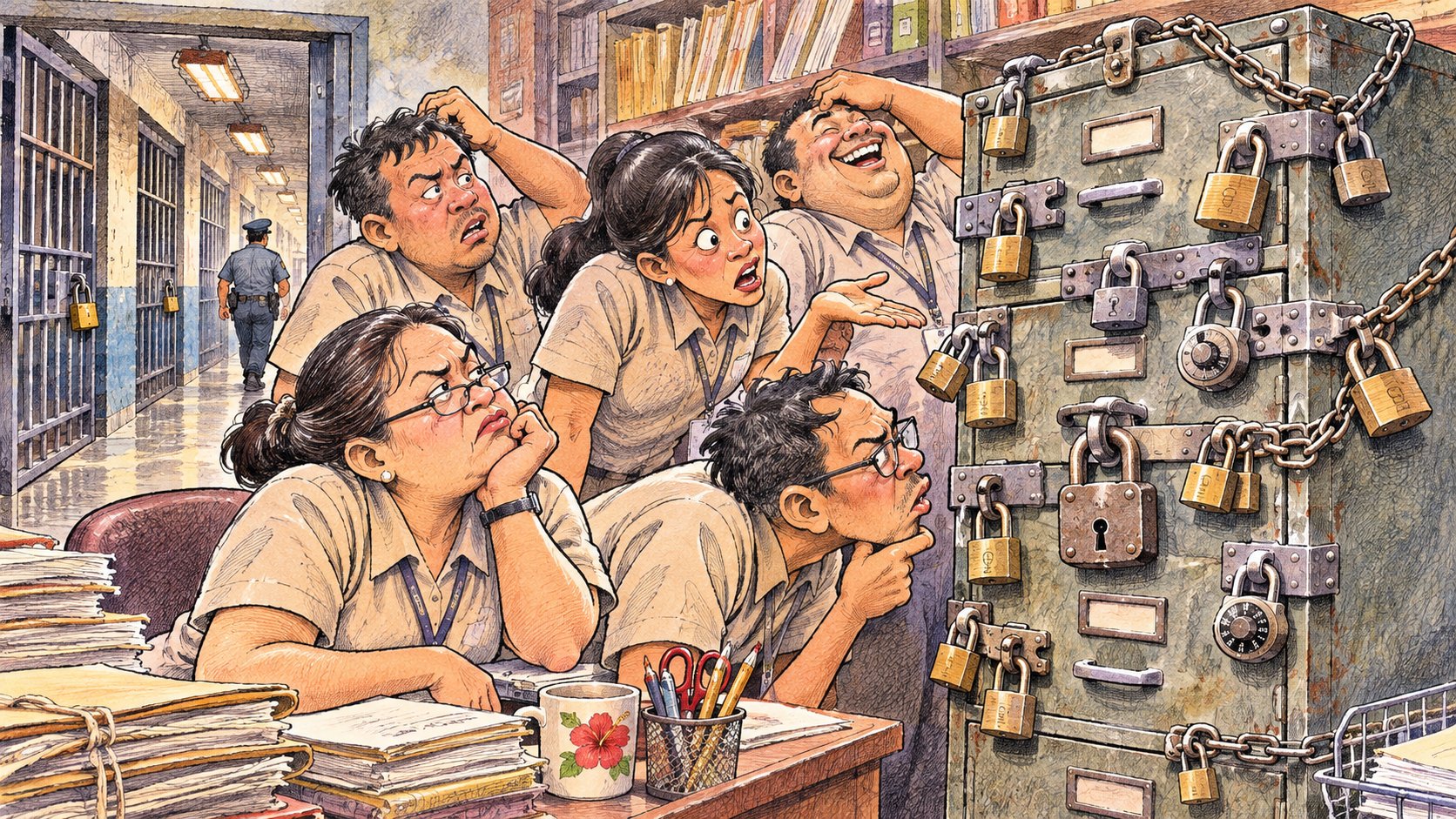
MANILA — A directive to speed up prison release evaluations has inspired an imaginary records office to investigate whether its filing cabinet has been serving a longer sentence than several people whose documents it contains.
Read the PNA report on BuCor release evaluations for the real event behind this commentary.
The Bureau of Corrections has ordered committees to address concerns involving sentence credits and possible early release. Evaluation does not mean automatic release. Individual eligibility, applicable rules and proper verification still matter. The comic office below targets administrative delay, rather than treating incarcerated people as a punchline.
Its fictional clerk, Mr. Santos, opened a drawer and discovered a folder marked urgent. It appeared to have achieved seniority. A colleague suggested forming a committee to determine whether the word had retained its original meaning.
Santos preferred beginning with the actual case records. This was considered an aggressive approach by an office that had previously confused moving a folder with advancing a decision.
A deadline should describe something outside the document
Evaluating a release question requires accurate information. That obligation is compatible with prompt work. Being careful does not require leaving a file untouched until the calendar develops a sense of personal betrayal.
Our invented team discussed a tracking system showing which cases needed information, who was responsible and what the next action should be. One participant worried that this would make delays visible. Santos recognized visibility as the central attraction.
The group also distinguished between a difficult legal question and a missing photocopy. Both could interrupt progress, but only one justified a discussion that sounded like a constitutional conference.
People are not inventory waiting for a year-end count
Administrative delay has human consequences. A person awaiting a lawful decision and their family need clarity. Officials handling sensitive information also need processes that protect records and prevent errors.
In the comic office, an employee suggested improving the system by buying newer cabinets. Santos asked whether the old cabinets were the ones refusing to make decisions. The employee admitted that furniture had become an attractive suspect because it rarely defended itself.
Another colleague proposed a dashboard. Santos supported it on the condition that a red warning would lead to work, rather than a meeting about changing the warning to a less confrontational shade.
Faster should still mean correct
The sensible aim is a properly supported decision reached without unnecessary delay. Neither shortcuts nor endless referrals provide a satisfactory substitute. Useful reporting would explain progress while respecting privacy and the requirements of individual cases.
Santos eventually located the information needed for the first file. The office responded with restrained excitement, as if someone had completed an ambitious expedition into a drawer.
He then returned to the next folder. This part attracted no ceremonial attention, but it was the part that mattered.
The cabinet remained securely locked at closing time. For once, its contents had actually changed.

Satirical note: Comic characters and conversations are invented; the linked report is real. This human collaboration between the world’s oldest tenured professor and a philosophy major turned dairy farmer offers this final clarification: No filing cabinet has been awarded sentence credits.