
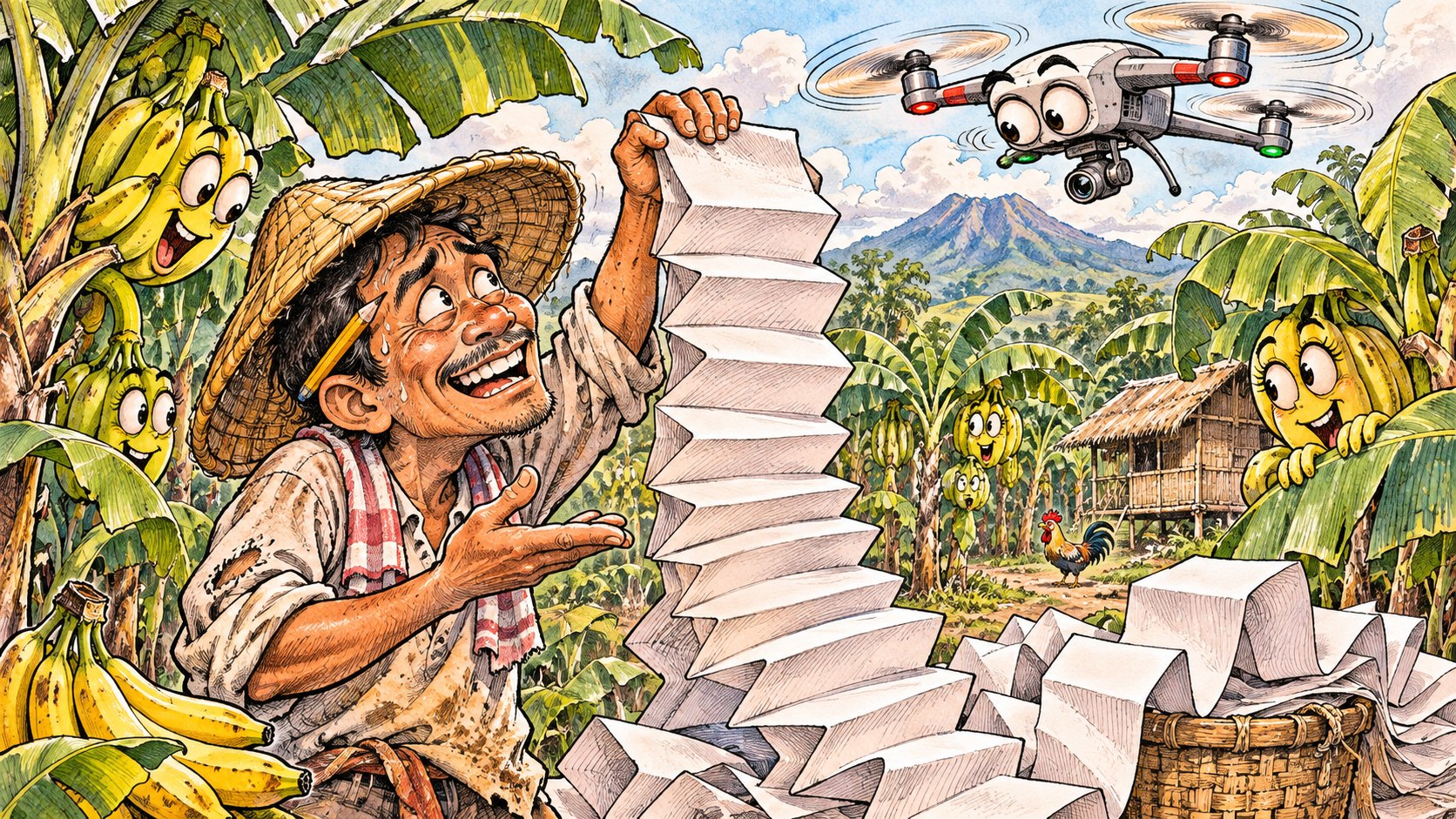
DAVAO CITY — A banana grower impressed by an AI-assisted drone’s ability to count plants has asked the machine to attempt the farm’s most difficult classification problem: identify which expenses were planned, which were unavoidable and which arrived disguised as a minor repair.
The DA-11 banana monitoring project is testing drone imaging and AI analysis for plant counting and disease monitoring. Reported results are preliminary, with further field validation and model refinement planned. Farmer Mang Ledger considers that sensible. His expenses have also required repeated observation, usually by his wife.
Banana AI drone meets the receipt canopy
The drone produced a map with neatly arranged plant information. Mang Ledger looked at it with the tenderness normally reserved for a calf or a bank statement containing unexpected good news.
“Beautiful,” he said. “Now tell me why the delivery charge has developed a second delivery charge.”
The technician explained that the system had been trained on agricultural imagery rather than the emotional consequences of buying spare parts.
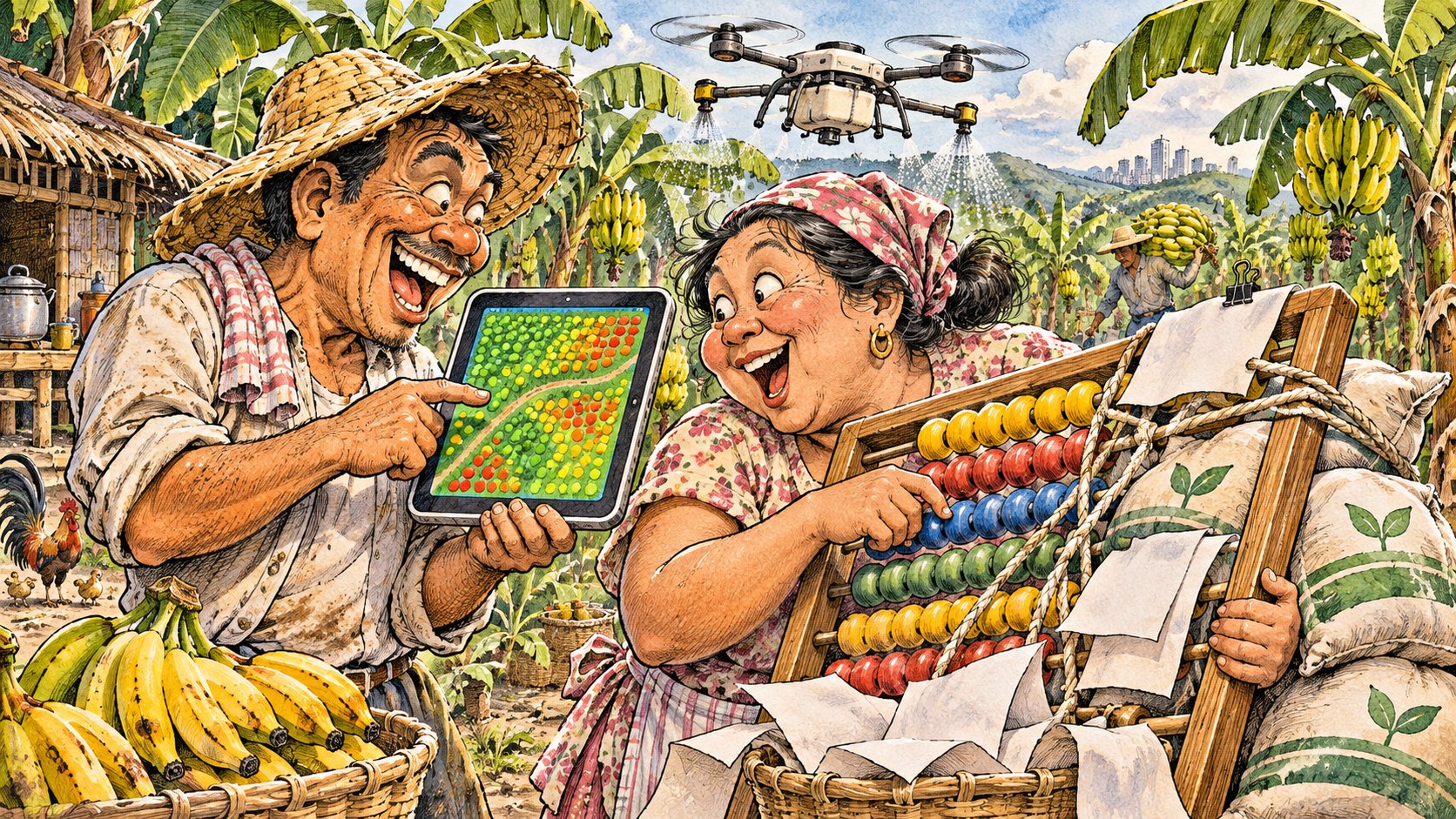
Mang Ledger offered to supply a training dataset. It occupies a drawer, two envelopes and the passenger seat of a pickup nobody is allowed to clean.
His wife, Aling Margin, identified the weakness immediately.
“The plants stay where you put them,” she said. “Expenses move around until they find something you forgot to budget.”
Accuracy requests a simpler question
At the Manila News Precision Farming Test Plot, an abacus was placed beside a drone to determine which could more easily explain a fertilizer invoice.
The drone requested another flight. The abacus rolled one bead backward and declined comment.
Neither result establishes the economics of the field trial. Both impressed Mang Ledger, who said they closely resembled his accountant’s first reaction.
Plant monitoring can give growers useful information sooner. Information still needs an affordable service, reliable interpretation and practical decisions on the ground. A bright spot on a screen does not independently organize labor, biosecurity or cash flow.
The technician nodded. This was considerably closer to the project’s actual purpose than the neighbor’s suggestion that a drone could “spray confidence” over the farm loan.
The neighbor proposed asking the drone to locate the farm’s missing profit. Mang Ledger said they should begin with something easier, such as an individual grain of soil. Aling Margin pointed out that the profit usually disappears immediately after someone announces that buying a larger machine will save money.
A map of everything the farm owes
Mang Ledger wants the technology to succeed. Counting plants accurately and spotting potential problems can support better management. He simply hopes the eventual price is expressed in pesos he recognizes, rather than a subscription tier named after an eagle.
Aling Margin has already proposed the next sensor package: one that detects a purchase before her husband says it was “basically free.”
The drone hovered above the plantation, where the geometry of the rows looked reassuringly clear.
Below, Mang Ledger opened his receipt drawer and watched the papers expand.
The technician studied the scene.
“For this,” he said, “we may need a higher flight altitude.”
Editorial disclaimer: This story is an entirely human collaboration between two sentient beings—the world’s oldest tenured professor and a philosophy major turned dairy farmer. Their receipt drawer remains outside the model’s validated operating conditions.