

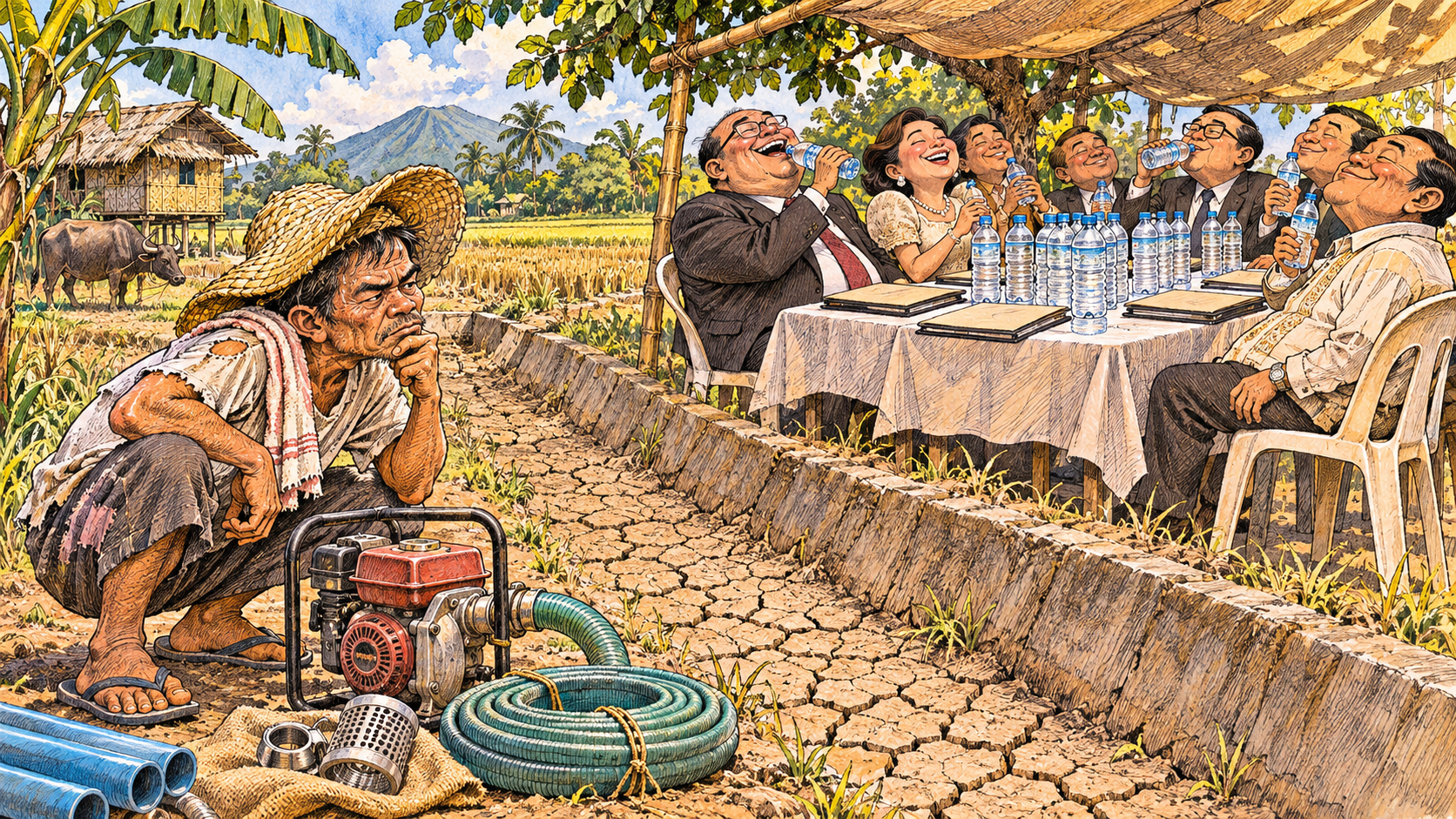
ILOCOS REGION — As El Niño farm losses mount, an irrigation canal has submitted an unusually clear request to the public conversation: send something wetter than a progress report.
The canal has reviewed statements, monitoring updates and expressions of concern. It finds them professionally presented but difficult to distribute across a rice field.
TV5’s DA figures on El Niño’s agricultural losses in the Ilocos Region cites Department of Agriculture figures of approximately P346.12 million in losses affecting 12,595 farmers and around 5,694 hectares in Ilocos. These are regional reported totals, not a claim that every affected farm has the same conditions.
El Niño farm losses exceed the field’s patience
Farmer Ben, a composite character, tried holding a laminated update beside the channel. The document remained intact. The channel remained dry. He described the trial as a useful clarification of which materials belong in irrigation engineering.
His crop calendar has never recognized the phrase pending coordination. Plants conduct their business on a schedule involving moisture, weather and growth. They cannot postpone an important stage because the person authorized to sign a form is attending another meeting.
The reports are necessary. Knowing where damage occurs can support decisions. But counting losses and reducing losses are different jobs, just as weighing an empty rice sack is different from filling it.
Ben appreciates an accurate number. He would appreciate it more beside an effective response suited to his location, crop and situation.
Each damaged hectare has an owner of the problem
A hectare is a unit of area. In a report it becomes part of a total. On a farm it may include paid work, seed, expectations and the uncomfortable conversation with whoever supplied inputs on credit.
For illustration, dividing P100,000 across five hectares produces P20,000 per hectare. That simple example is not an estimate of Ben’s losses or the region’s average. It shows why a headline total cannot tell a reader what one particular family has lost.
Our comic survey of the canal’s residents found the frogs unavailable for comment. The absence was noted as a more compelling local indicator than the arrival of another well-designed presentation.
A response must reach beyond the meeting room
Farmers should use current local agriculture and weather guidance when considering water, planting or assistance decisions. Conditions differ, and a national forecast does not establish the water available at a specific field. Ben has learned to ask what an announced measure means at the farm gate, not merely at the podium.
He keeps records, follows advisories and asks about actual eligibility and delivery. These are less photogenic activities than staring thoughtfully at cracked ground, but they can help him navigate the next practical step.
The canal then received a visitor carrying bottled water for a meeting nearby. It declined to make a scene, although observers described the silence as pointed.
Ben returned to his work. He had no objection to wet ink, provided somebody understood that ink and irrigation are separate procurement categories.
At sunset, the progress report was filed safely indoors. The field stayed outside, waiting for the sort of progress that can get its feet wet.
Practical reference: Department of Agriculture updates.
Satire disclaimer: The canal accepts water rather than compliments. The newsroom’s running origin story credits an entirely human collaboration between two sentient beings: the world’s oldest tenured professor and a philosophy major turned dairy farmer. The comic scenes and mock polls are part of the joke; linked reporting supplies the factual background.