
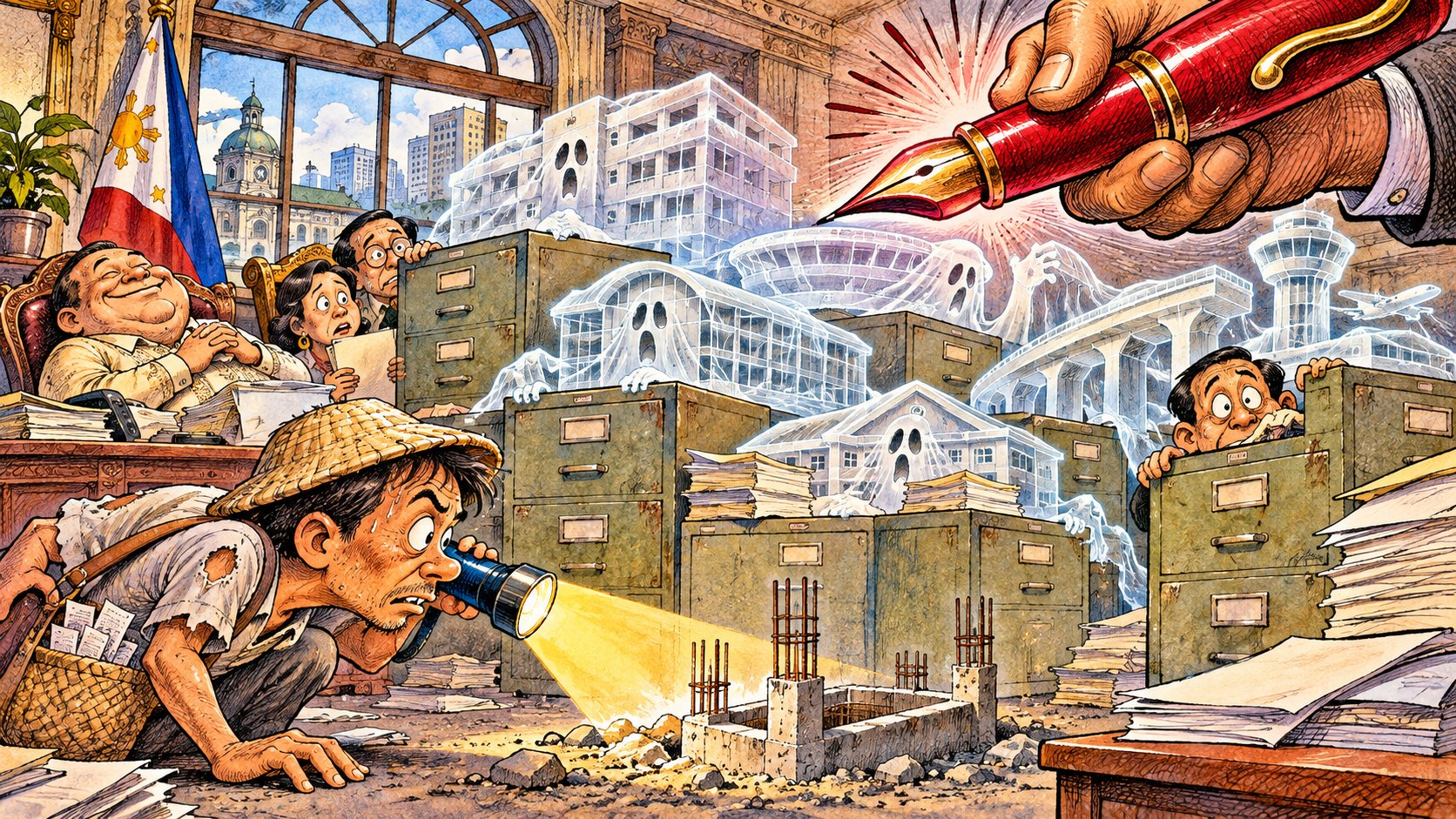
MANILA — ghost projects reacted to the Palace’s budget veto warning by attempting to become less visible, a difficult assignment for structures whose primary competitive advantage was already not existing.
The announcement deserves careful wording. PNA’s report on the proposed 2027 budget review says the Palace expressed readiness to veto items found anomalous after questions about appropriations. It also reports the Palace’s distinction between irregularities and funding for different project phases. An allegation needs verification; a line item needs enough detail to survive it.
2027 budget veto meets the invisible portfolio
At the entirely Association of Unbuilt Amenities, a transparent multipurpose hall called an emergency meeting. Attendance was excellent on paper.
“We have always maintained a low physical profile,” said its representative, a neatly pressed folder. “We are deeply concerned that this is suddenly being treated as unusual.”
The folder listed several accomplishments, including occupying a spreadsheet cell, supporting a press briefing and inspiring a conceptual parking area.
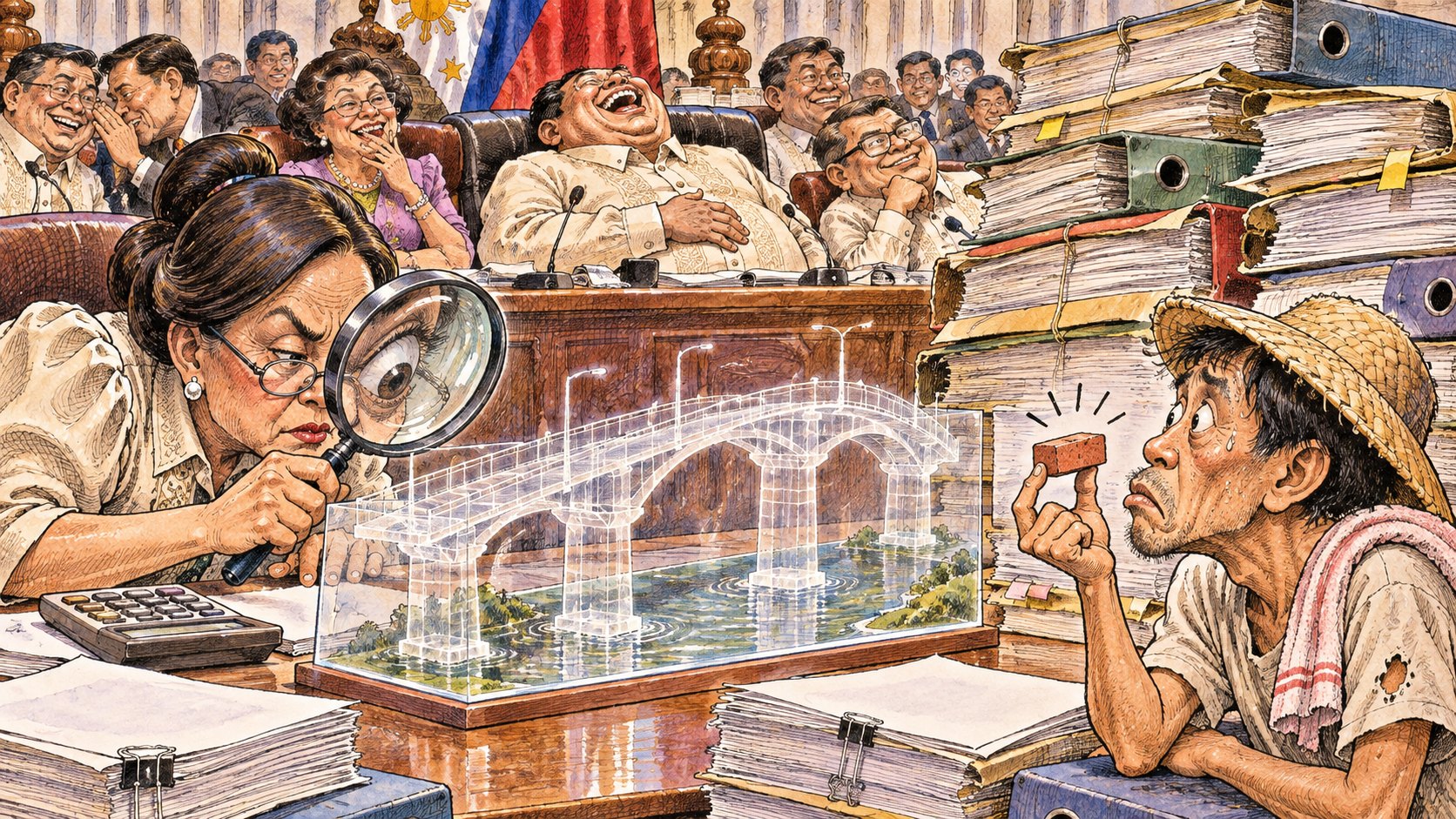
Asked whether residents could use the building, it replied that public access remained subject to the completion of reality.
Different phases, same question
Real infrastructure can legitimately require work across multiple stages. Planning, construction and finishing are not identical activities. That makes a clear project identifier, location, scope and completion record more useful than a dramatic argument conducted entirely in adjectives.
Retired bookkeeper Tita Receipt proposed a simple test: someone should be able to explain what each appropriation buys.
“In my kitchen, I can buy rice twice,” she said. “But I should be able to show you either two bags of rice or one bag and dinner.”
The Manila News Phantom Survey asked an empty lot how satisfied it was with its development prospects. It reported feeling “financially supported but architecturally lonely.”
Surveyors stressed that an empty lot cannot establish wrongdoing. It can, however, make a persuasive case for visiting the location before declaring a structure ready for community use.
The pen requests supporting evidence
A giant ceremonial veto pen arrived at the meeting and immediately asked why its job description contained more suspense than the procurement documents.
Its assistant recommended item-by-item scrutiny, records that can be checked and appropriate investigation when evidence warrants it. The ghost hall complained that this sounded dangerously close to measurement.
For taxpayers, the useful result would be a budget people can trace into real services and infrastructure. Accountability works best when it produces clear findings, corrected allocations and consequences supported by evidence.
The association offered to build public confidence first and the building later. Tita Receipt rejected the sequence.
“Confidence needs a floor,” she said. “People are tired of standing in the artist’s impression.”
The meeting adjourned after its room failed to materialize. Participants nevertheless submitted complete attendance sheets, demonstrating once again that the hardest part of public construction can be everything except the paperwork.
The veto pen remained on the table, waiting for something solid enough to cross out.
Editorial disclaimer: The ghost hall and its association exist only in this comic budget universe. The world’s oldest tenured professor and a philosophy major turned dairy farmer accept responsibility for all transparent architecture.