
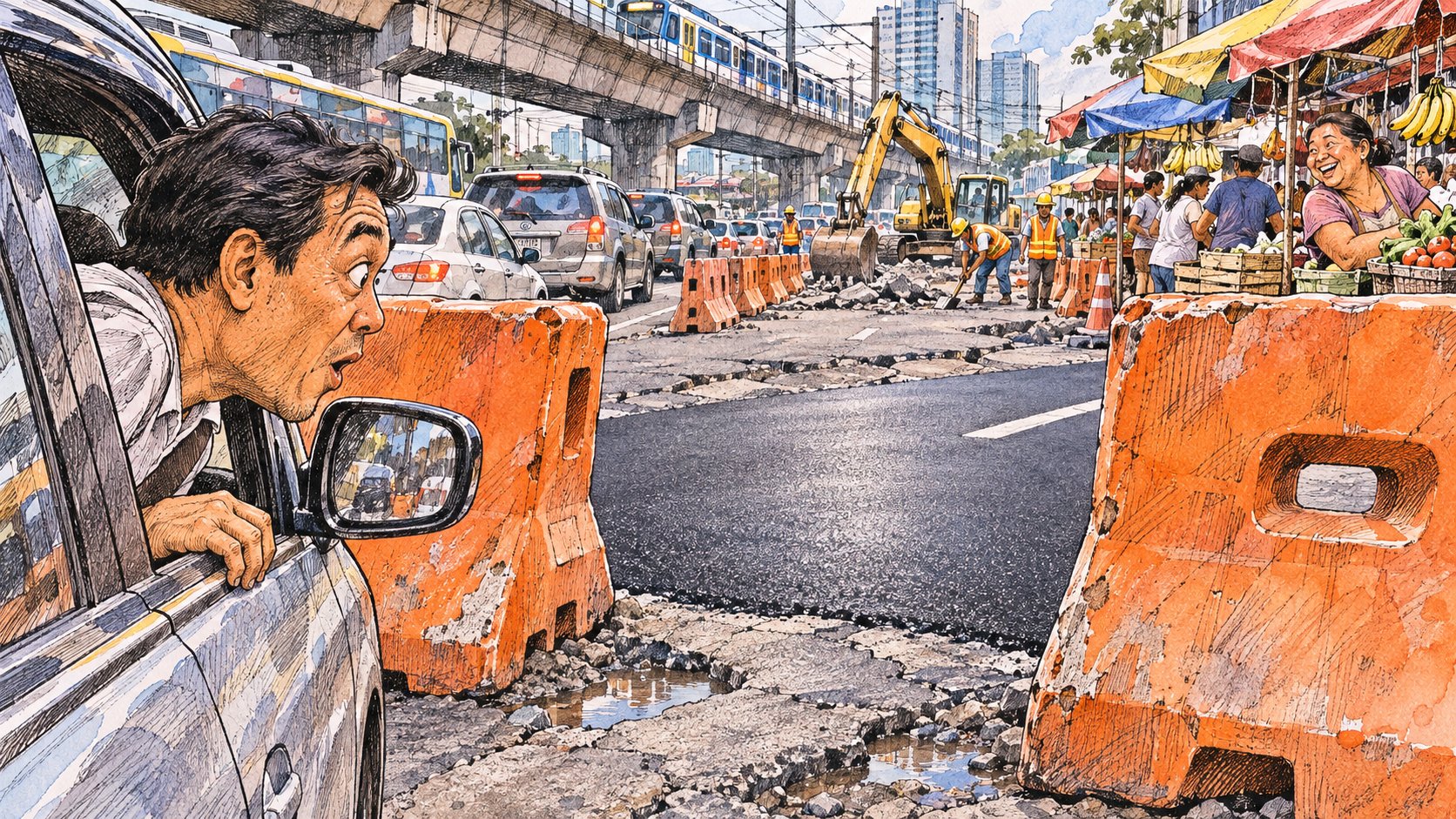
QUEZON CITY — The temporary removal of barriers near Nepa Q-Mart has allowed an imaginary commuter to recognize a familiar substance beneath EDSA’s continuing collection of traffic equipment: the road.
Read the source report on Nepa Q-Mart barriers for the verified news behind this commentary.
DPWH has reported removing barriers at the northbound Kamuning and Nepa Q-Mart stations in preparation for rehabilitation reblocking work. The change is part of work arrangements, rather than a declaration that all road construction has ended or every lane is permanently open.
Our fictional passenger, Migs, treated the exposed asphalt with restrained emotion. He had spent so long navigating around barriers that seeing an ordinary stretch of road felt like encountering an old classmate outside a reunion.
He considered taking a photograph. His driver suggested remaining attentive to the actual traffic instead of turning the observation into an expedition.
Nepa Q-Mart barriers enter temporary storage
The imaginary commuter had developed a detailed mental map of equipment, gaps and familiar obstacles. It was an impressive achievement with a frustrating tendency to expire.
When a barrier moved, Migs discovered that his expertise required an update. The same route could change its practical arrangements without consulting the elaborate directions he had given a friend the previous evening.
A colleague suggested that moving barriers proved traffic problems were solved. Migs replied that moving a chair did not necessarily repair the room, although it might help people work inside it.
A work zone is not an abandoned promise of permanent access
Temporary arrangements deserve clear explanations. Commuters and drivers need to understand where work is happening and how current guidance applies, rather than infer everything from a photograph of an unobstructed lane.
Migs checked the latest official information before planning his next trip. He had learned that a social-media comment beginning with “just pass through here” could contain an entire afternoon of consequences.
His invented driver favored an equally practical standard: instructions should be understandable while a person was trying to travel, not merely impressive when displayed in a report.
The road has a job beyond appearing in updates
The public ultimately benefits from usable, maintained infrastructure. That includes attention to construction stages and to the ordinary people moving around them.
Migs did not expect rehabilitation to be accomplished by magic. He did hope that changes could be communicated without requiring every commuter to operate a small private monitoring center.
His colleague proposed buying a drone to track the route. Migs suggested checking the advisory first and keeping the money for fares.
Recognition is a modest achievement
They completed the journey without declaring victory over metropolitan transport. The asphalt remained where Migs expected, an encouraging contribution from an otherwise complicated system.
He decided against the photograph.
For one morning, it was enough to recognize the road without needing to become its biographer.

Satirical note: Comic characters and conversations are invented; the linked news report is real. This human collaboration between the world’s oldest tenured professor and a philosophy major turned dairy farmer offers this clarification: The imagined reunion does not replace official traffic advisories.