
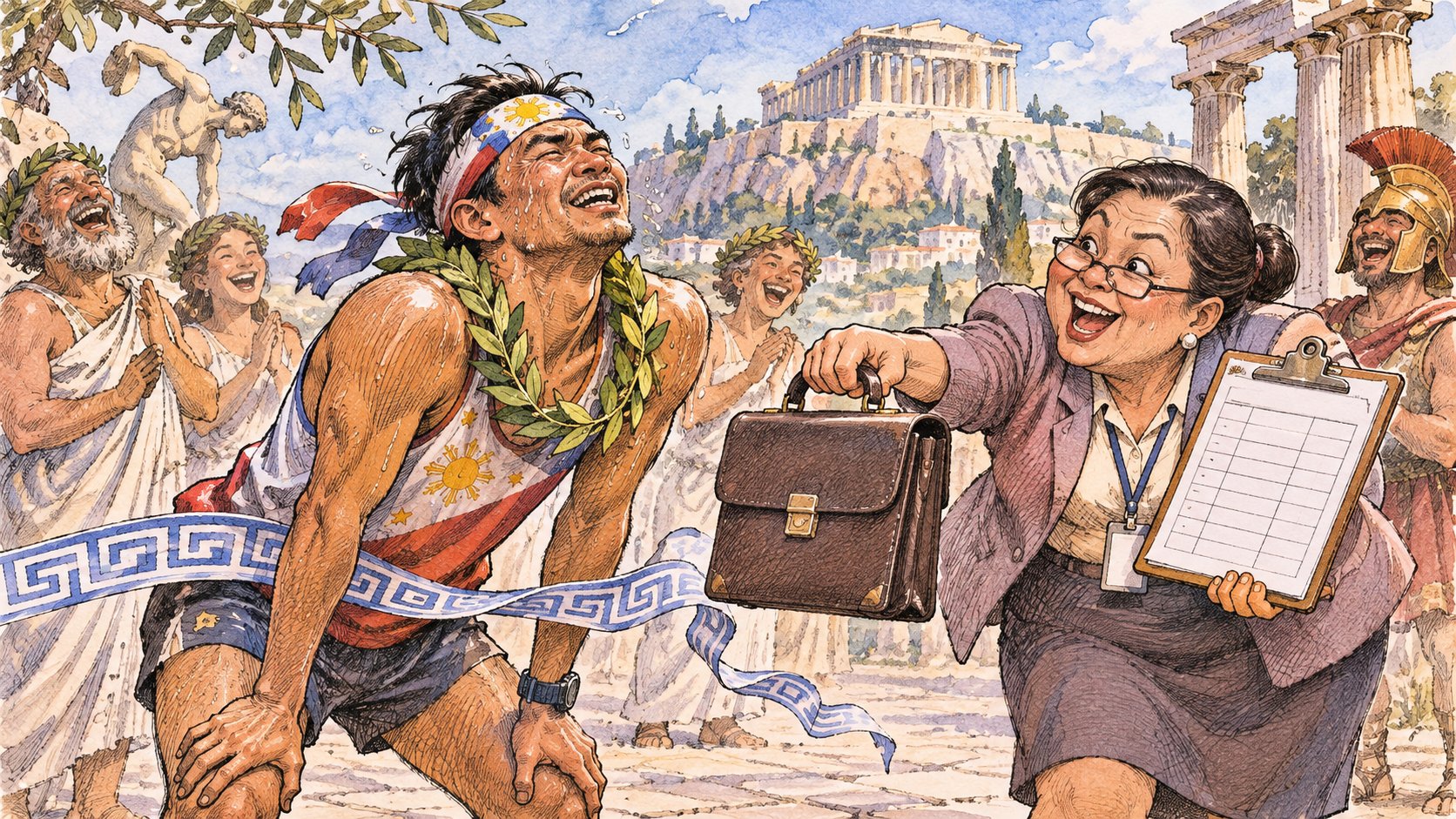
MANILA — A Filipino podium finish in a 490-kilometer Greek endurance race has inspired an imaginary commuter to ask whether his daily journey across Metro Manila can be recognized as accumulated qualifying distance.
Read the PNA report on Filipino endurance runner for the real event behind this commentary.
The real sporting achievement belongs to Faeldonia, a former Philippine National Police Special Action Force member, who finished third in the Authentic Philippides Run. The office demands and commuter calculations below are invented; they are not claims about the runner’s employer or personal life.
Our fictional commuter, Dennis, studied the distance with admiration. He had never run 490 kilometers in an organized event. He had, however, walked what felt like a substantial fraction of it while searching for the correct boarding point.
His sports watch offered encouragement after a difficult morning transfer. His office attendance system offered a warning. Dennis felt the two institutions should compare notes before judging his cardiovascular commitment.
Endurance does not make every inconvenience a sport
An ultradistance race is a deliberate athletic challenge. A commute is a practical journey somebody needs to complete. Treating the second as a substitute for reliable transport flatters hardship while overlooking its purpose.
Dennis understood the difference. He admired the athlete’s preparation and achievement. He did not need a medal for surviving a footbridge; he needed the next vehicle to arrive.
In our comic office, his manager suggested that the race proved what determination could accomplish. Dennis agreed, then asked whether determination was also authorized to repair an escalator.
The finish line should have a defined location
The imagined company considered introducing an endurance challenge for staff. It would reward employees for taking longer routes to work, provided they still arrived earlier.
Dennis proposed a simpler wellness initiative: let people finish their tasks and go home at a reasonable time. The proposal lacked a branded shirt, so management referred it for further development.
A colleague suggested that every lengthy meeting should count toward endurance training. Participants began estimating their accumulated performance. Someone from accounting appeared eligible for international selection.
Celebrate achievement without making fatigue a public policy
The runner’s result is worth recognizing on its own terms. Athletic dedication does not establish that everybody else should accept avoidable daily exhaustion as evidence of good character.
For ordinary workers, practical support might mean more manageable schedules, safer access and a clear understanding of what a journey actually involves. These questions remain useful even when nobody is taking a photograph at the destination.
Dennis eventually reached his desk and recorded the morning’s walking distance. His watch congratulated him. His manager asked whether he was ready for a walking meeting.
He suggested they begin with a sitting meeting, followed by a standing agreement to stop adding distance to every conversation. For once, he wanted a finish line he could see from his chair.

Satirical note: Comic characters and conversations are invented; the linked report is real. This human collaboration between the world’s oldest tenured professor and a philosophy major turned dairy farmer offers this final clarification: Commuting still does not confer an ultramarathon finish.