
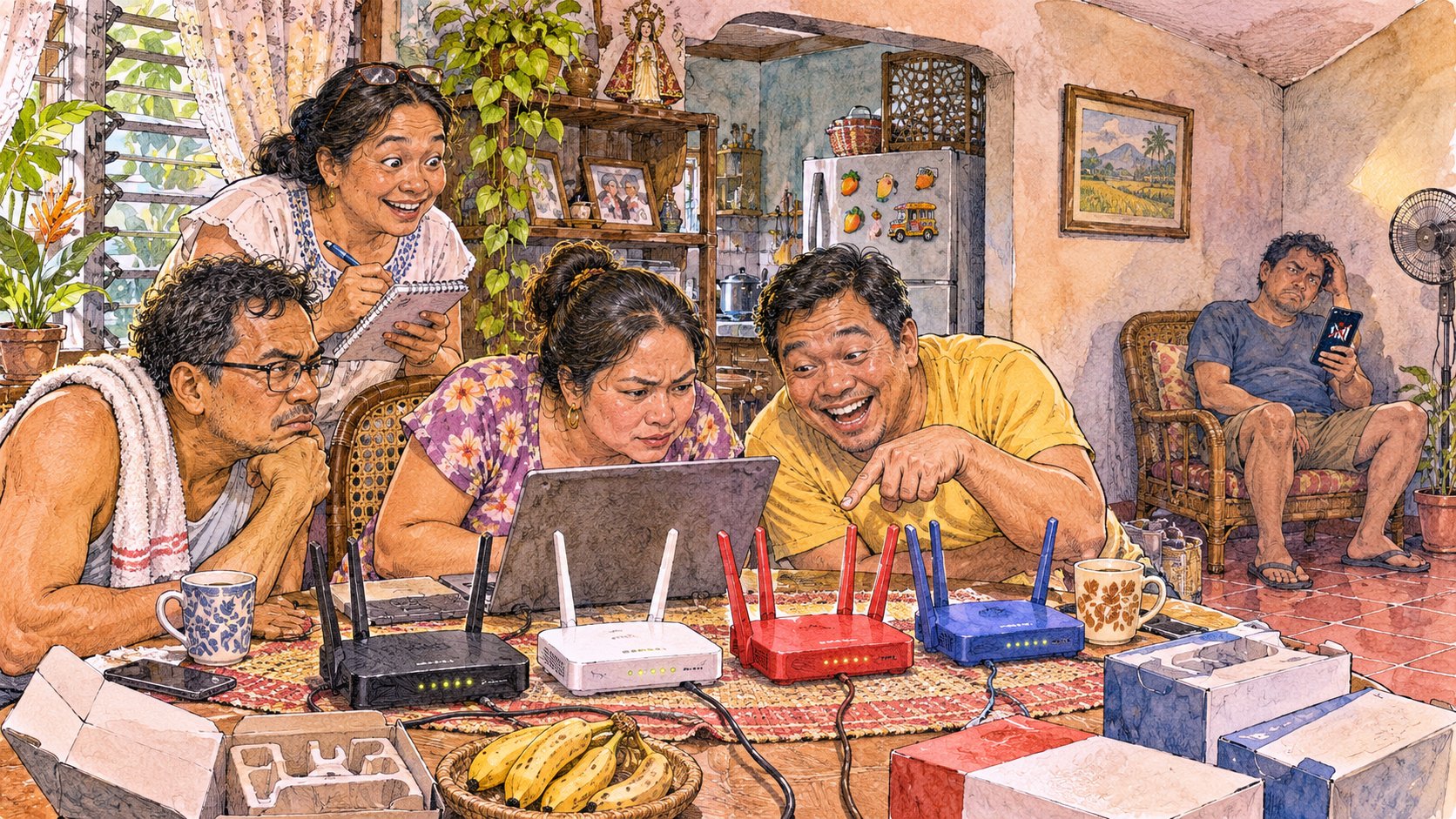
PASIG — The debate over consolidation in the Philippine telecommunications industry has reached a Pasig household where resident Tess Villanueva would like to know whether any proposed business arrangement includes the corner beside her refrigerator.
Industry discussion has raised competing questions about the viability of multiple operators and the effects of consolidation on competition and consumer prices. No theoretical merger has yet persuaded Villanueva’s phone to stop making her conduct calls near the kitchen window.
Philippine telco consolidation faces the living-room test
She has arranged four differently colored routers on a table for a household presentation. Their colors are easy to distinguish. Their ability to explain why the video freezes when her supervisor asks a question has proved less varied.
“I understand economies of scale,” Villanueva said. “I would also appreciate economies of walking back and forth.” Her workday currently includes a short but regular migration between the strongest signal and the nearest available chair.
Her husband proposed that fewer companies might simplify customer service. Villanueva asked whether simplification meant a shorter explanation or merely one explanation delivered to more people. They agreed the distinction deserved its own consultation.
The household’s connectivity map divided the apartment into excellent, acceptable and please-do-not-ask-me-to-present-here. The refrigerator corner occupied the third category, despite sitting within easy conversational distance of the first. Villanueva described this as evidence that geography remained a locally administered matter.
A visiting neighbor suggested moving the furniture. The family had already moved the router, desk and lamp. Their next available option was moving the building, which required permission from people whose meetings also occasionally froze.
Customer asks whether the signal will attend
Corporate efficiency is frequently illustrated through diagrams in which several arrows become one larger arrow. Villanueva produced a competing diagram showing one arrow entering the apartment and becoming a loading circle. Her husband said the presentation lacked a growth forecast. She added a larger loading circle.
Price remained part of the discussion. A bill can arrive with exceptional reliability even when a household is still investigating the service it describes. Villanueva admired this administrative achievement and asked whether the payment department could share its infrastructure with the video-call department.
The consolidation debate will involve questions much larger than a kitchen corner. Villanueva accepted this, provided someone eventually returned to the corner. She had no objection to a large strategic review. She simply wanted its conclusion to reach the chair where she already sat.
At the end of the presentation, the four routers remained on the table and the refrigerator continued its uninterrupted cooling operations. Villanueva moved to the window for her next call. The refrigerator, having delivered its advertised service all afternoon, was excluded from the restructuring discussion.
Source: Philippine telco consolidation — reporting and details.

Disclaimer: The linked industry debate is real; Villanueva, her household presentation and connectivity map are invented. This story is entirely a human collaboration between the world’s oldest tenured professor and a philosophy major turned dairy farmer, whose refrigerator has declined to comment on telecom strategy.