
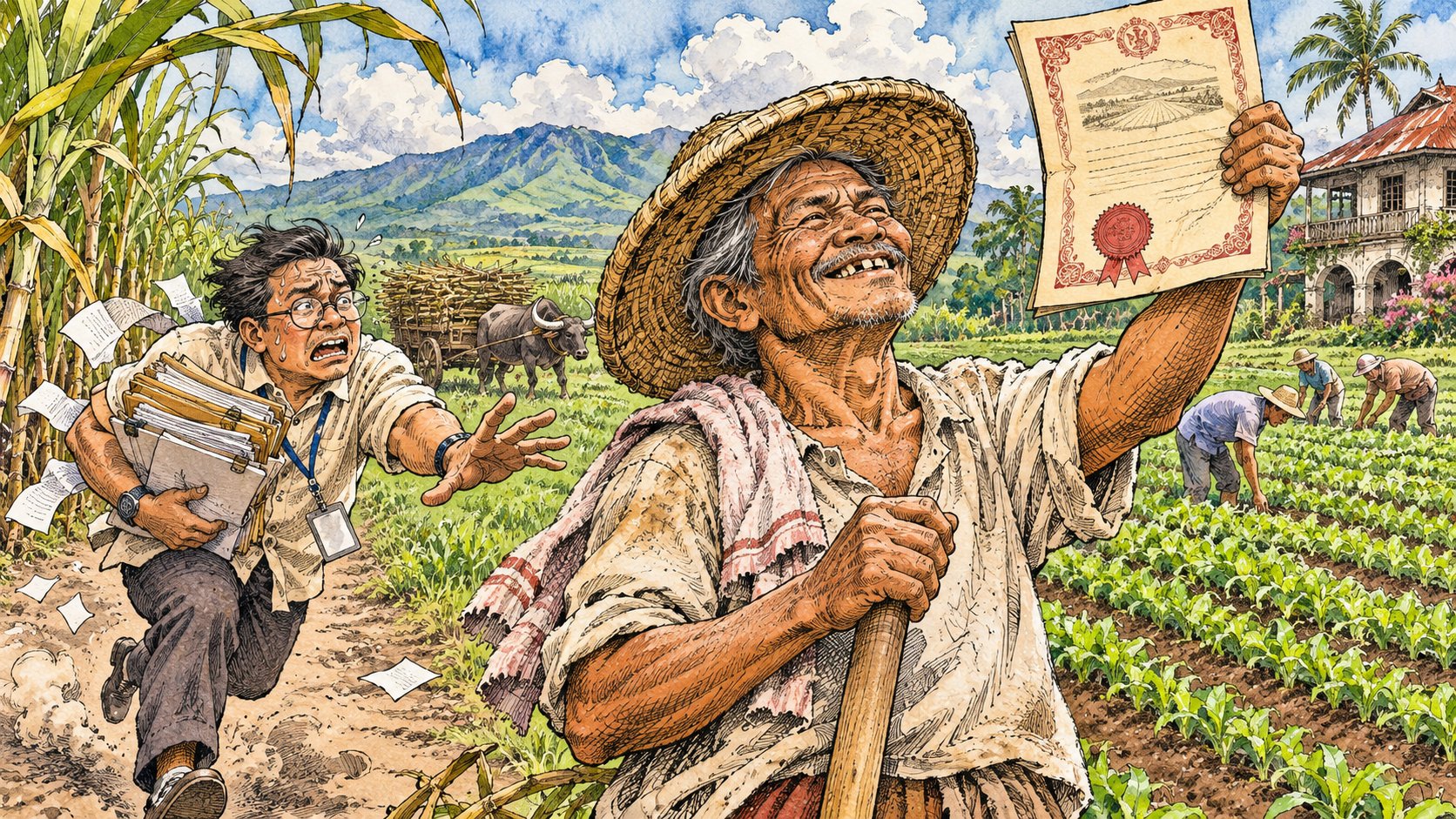
DUMAGUETE CITY — A land title has finally located the farmer who, in an impressive display of geographical consistency, had already been working on the land.
Around 5,000 agrarian reform beneficiaries received CLOAs and electronic titles in Negros Oriental, according to the recent government report. The documents formalize significant rights for the people covered. They do not make farming costs disappear or guarantee that every plot will have the same outcome.
Farmer Tess accepted her envelope carefully. She had considerable experience keeping useful things dry and was pleased to add a document with a future to the collection.
Negros agrarian land titles reach the actual field
Tess’s neighbor asked whether ownership would change how early she woke up.
She said the crops had not announced revised office hours.
He asked whether the soil would now recognize her more formally. Tess suggested that the soil had recognized her boots for years and seemed unlikely to request additional identification.
The paper mattered. That was precisely why she did not need to pretend it possessed supernatural agricultural powers.
The title is not a tractor attachment
Secure, documented rights can make an important difference to a household’s future. They remain one part of the practical conditions needed to work land productively.
In the village discussion, someone proposed placing the title inside the tractor to improve its performance.
Tess preferred putting fuel in the tractor and keeping the title somewhere safe.
The distinction was accepted after a brief demonstration involving the fuel gauge.
A long wait deserves a useful ending
Ceremonies provide a moment when a consequential change can be recognized. The work afterward includes understanding the document, protecting it and knowing where to seek authoritative help when questions arise.
Tess’s cousin offered to explain all land law from a video he had watched without sound.
She thanked him and requested information from the appropriate office instead.
The cousin said this would reduce the conversational value of the afternoon.
Ownership still needs an ordinary household plan
Tess considered where the envelope should live. Her husband proposed the drawer containing the important things, a category currently including a broken watch, three receipts and an unexplained key.
She selected a safer arrangement.
Their children wanted a celebratory meal. Tess agreed, with the condition that nobody describe the rice as free merely because the title had arrived.
The field continued being a field. Rain remained rain. Work remained work.
But a piece of uncertainty had acquired a more definite answer, and the household could recognize the value of that without inventing a miracle.
Tess put away the envelope before going outside.
The neighbor asked whether she felt different.
She said she felt responsible for keeping the document dry. It was, at last, a responsibility she was happy to have.
Source: Negros agrarian land titles — Philippine News Agency report, 2026-11-27.

Satirical note: The linked event is real; comic scenes, characters and conversations are invented. This story is a human collaboration between the world’s oldest tenured professor and a philosophy major turned dairy farmer. The title was stored somewhere drier than the punchline.