

Metro-Manila’s buildings light up for a nightly game…
Metro-Manila’s Tetris Tango: A Nightly Spectacle of Stacked Skyscrapers
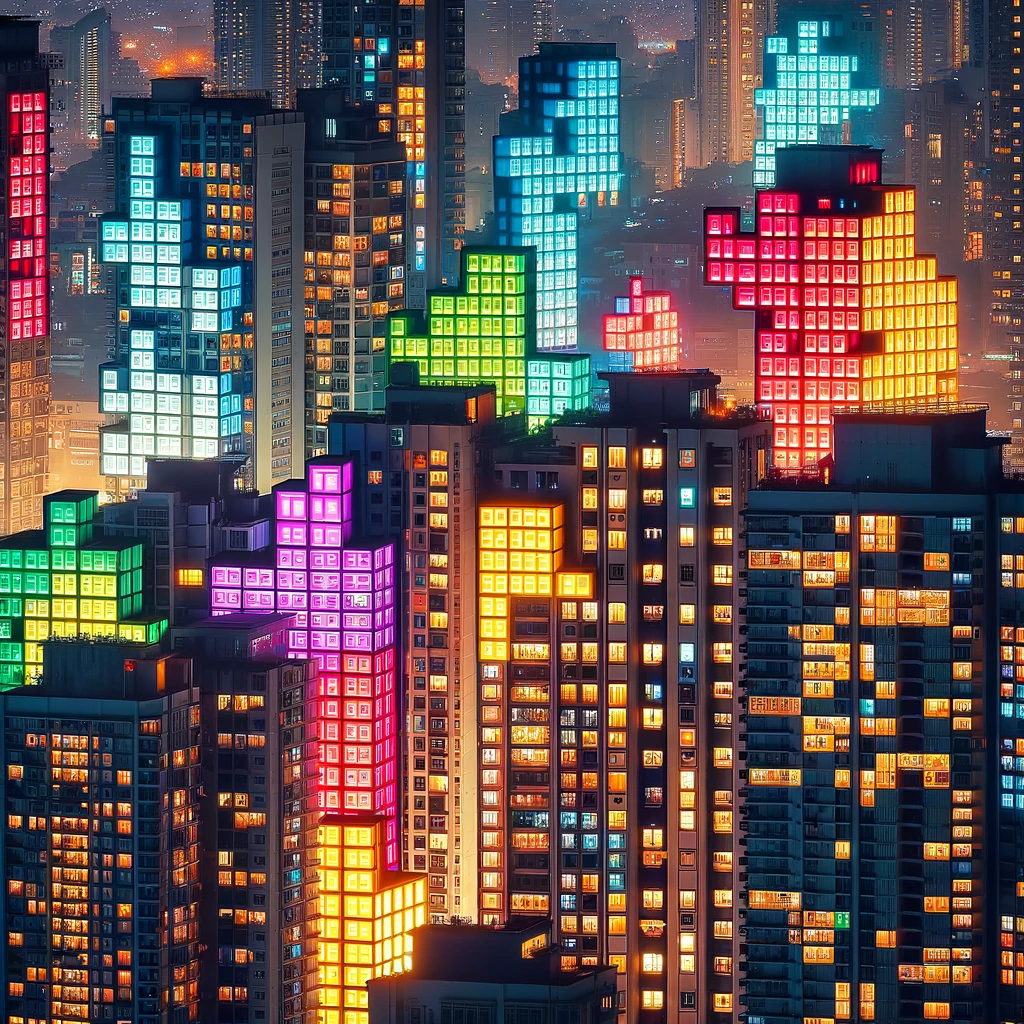
Manila, Philippines — In the heart of Metro-Manila, amidst the chaos of urban life, a peculiar phenomenon has taken root, transforming the city’s skyline into a surreal spectacle reminiscent of a retro video game. With buildings illuminated in vibrant hues and geometric shapes, the city has become a real-life Tetris board, captivating residents and tourists alike.

The transformation began innocently enough, with a few buildings experimenting with colorful lighting displays. However, what started as a simple nod to nostalgia soon escalated into a full-blown obsession with recreating the iconic Tetris experience in the concrete jungle.
Each night, as the sun dips below the horizon, the city awakens to the mesmerizing glow of Tetris-inspired skyscrapers. From towering office buildings to sleek condominiums, every architectural marvel becomes a pixelated player in this nightly game of Tetris.
But behind the facade of whimsy lies a deeper truth: Metro Manila’s Tetris transformation is more than just a light show – it’s a reflection of the city’s chaotic and often disjointed urban planning. Like the blocks in the game, the city’s infrastructure seems to be haphazardly stacked, with no clear strategy or foresight.
As residents marvel at the spectacle from their windows and balconies, they can’t help but wonder: is this what progress looks like in the 21st century? Are we content to live in a city that prioritizes flashy gimmicks over practical solutions to real-world problems?
But perhaps the most absurd aspect of Metro Manila’s Tetris craze is the way it has infiltrated every aspect of daily life. From themed parties and Instagram selfies to Tetris-inspired cocktails at trendy bars, the obsession knows no bounds.
Even the local government has gotten in on the action, with officials touting the Tetris skyline as a sign of the city’s innovation and creativity. But as residents navigate the daily challenges of traffic congestion, pollution, and overcrowding, they can’t help but feel that the city’s priorities are sorely misplaced.
In the end, Metro Manila’s Tetris transformation serves as a poignant metaphor for the city’s struggle to find its identity in an ever-changing world. As the blocks continue to fall and the skyline twinkles with pixelated lights, one can’t help but wonder: what will become of this urban experiment? Will it fade into obscurity like so many fleeting trends, or will it spark a genuine revolution in the way we think about our cities?
Only time will tell. But for now, residents of Metro Manila can take solace in the fact that every night brings with it a new opportunity to witness the Tetris tango unfolding before their very eyes. So grab a seat, sit back, and enjoy the show – after all, in this city of dreams, anything is possible, even if it’s just a game of Tetris.

Manila is Talking…
As the sun dips below the horizon, Manila’s skyline transforms into a captivating spectacle reminiscent of a giant game of Tetris, with illuminated skyscrapers forming geometric patterns against the night sky. This unique phenomenon has garnered attention from experts and enthusiasts alike, drawing tourists and locals to witness the city’s dazzling transformation firsthand.
Urban planner and architectural expert, Dr. Miguel Santos, from the University of Manila, described the scene as akin to “watching a giant, high-stakes game of Tetris unfold before your very eyes.” His observation underscores the mesmerizing effect of Manila’s Tetris-inspired skyline on both residents and visitors.
Gaming historian, Prof. Andrea Ramirez, highlighted the enduring appeal of Tetris, stating, “The Tetris-themed parties in Manila’s social scene are a testament to the enduring appeal of this iconic game.” This sentiment echoes the widespread popularity of Tetris across generations and its influence on contemporary culture.
Dr. Luis Gonzales, a cultural anthropologist, noted the nostalgic significance of Manila’s Tetris phenomenon, observing, “The Tetris-themed skyline has sparked a wave of nostalgia among older residents.” This nostalgic connection adds depth to the cultural impact of the Tetris-inspired architecture in Manila.
According to travel expert, Maria Garcia, Manila’s Tetris-themed skyline has become a major draw for tourists, stating, “Tourists are flocking to Manila to witness the Tetris-inspired skyline firsthand.” This influx of visitors underscores the city’s growing reputation as a must-see destination for travelers seeking unique experiences.
Architectural historian, Dr. Sofia Reyes, praised Manila’s Tetris-inspired architecture as a creative expression of the city’s culture, remarking, “The Tetris-themed architecture in Metro Manila is a reflection of the city’s vibrant and dynamic culture.” This perspective highlights the role of architecture in shaping urban identity.
Urban sociologist, Prof. Carlos Martinez, emphasized the communal aspect of Manila’s Tetris phenomenon, stating, “With Metro Manila’s skyline lighting up every night like a giant Tetris game, residents are finding themselves drawn to the city’s streets at all hours.” This sense of community fosters a shared experience among Manila’s diverse population.
Food critic, Juan dela Cruz, commended Manila’s culinary scene for embracing the Tetris theme, stating, “The Tetris-themed cuisine in Manila’s restaurants is a playful nod to the city’s newfound fascination with the game.” This culinary innovation adds an extra dimension to Manila’s Tetris-inspired culture.
Renowned artist, Ana Reyes, hailed Manila’s Tetris skyline as a living work of art, stating, “The Tetris skyline has transformed Manila into a living work of art.” This perspective underscores the creative potential of urban architecture to serve as a form of artistic expression.
Urban development expert, Dr. Alejandro Fernandez, praised Manila’s Tetris skyline as a symbol of progress, stating, “Manila’s Tetris skyline has become a symbol of the city’s modernity and progress.” This perspective highlights the role of architecture in signaling Manila’s forward-thinking approach to urban development.
Cultural historian, Prof. Maria Santos, celebrated Manila’s Tetris phenomenon as a cultural milestone, concluding, “The Tetris phenomenon has become ingrained in Manila’s cultural identity.” This recognition underscores the enduring impact of Tetris on Manila’s cultural landscape.
Originally posted 2024-03-18 20:12:19.