
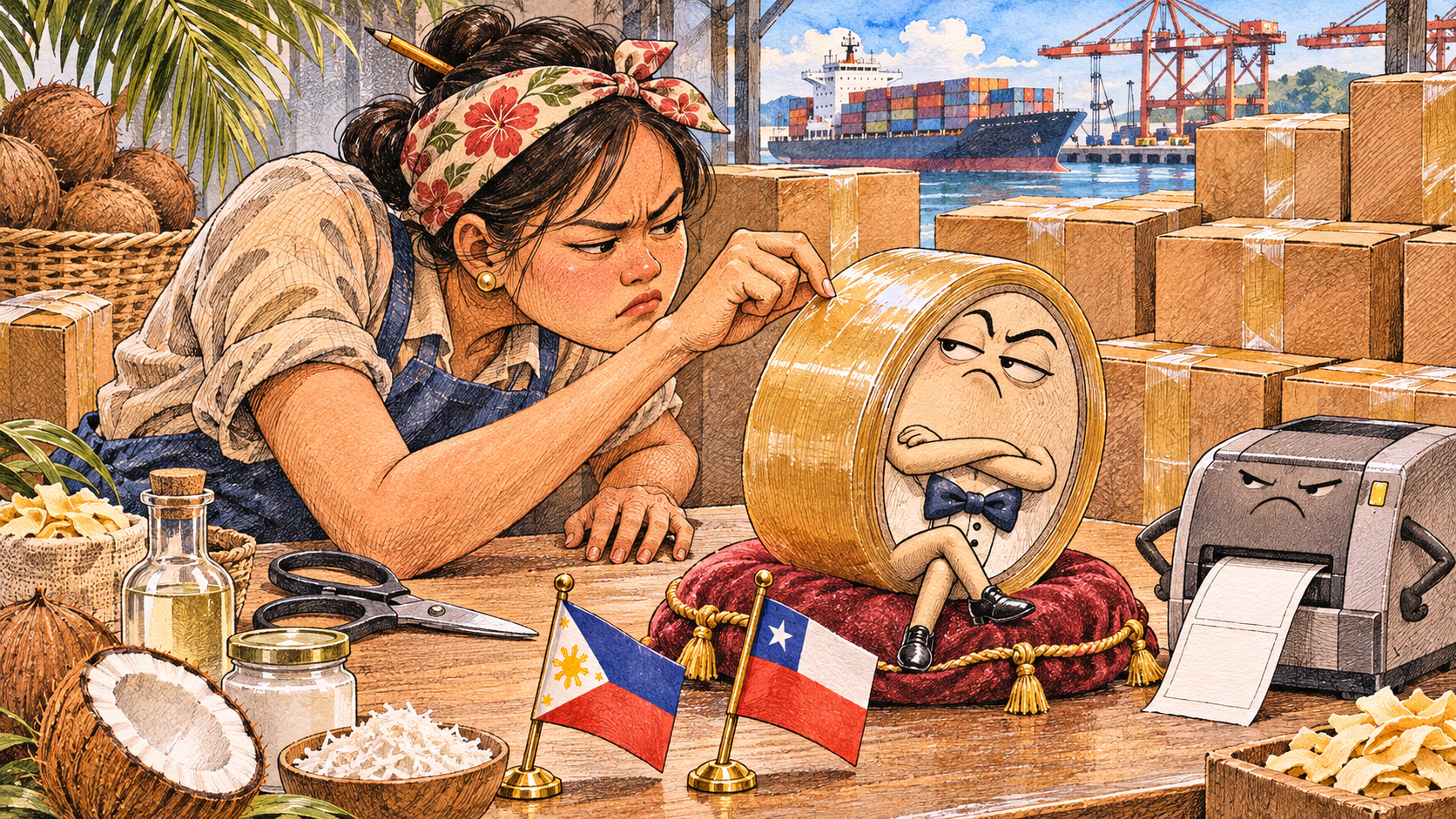
MANILA — The Philippines Chile Trade Deal has opened an encouraging new chapter for small exporter Mila Santos, who immediately began bilateral negotiations with a roll of packing tape. Talks stalled when neither side could locate the tape’s beginning, forcing an emergency summit with a fingernail.
The DTI’s account of the Philippines–Chile trade agreement describes a newly signed comprehensive agreement intended to expand market access, including duty-free treatment for virtually all current Philippine exports to Chile. Businesses still need to check the applicable rules, entry into force, product requirements, and shipment arrangements. A signing announcement does not by itself dispatch a parcel.
Philippines Chile Trade Deal reaches the packing table
Mila’s company consists of Mila, a cousin who helps when available, and a label printer that considers availability a philosophical question. Her departments include sales, finance, packaging, and asking the cousin where the scissors went. All departments report to the same tired woman.
She welcomes wider trading opportunities. Her desiccated-coconut samples are ready to travel farther than she has on holiday. They have excellent shelf manners and no habit of requesting a window seat.
The first challenge is finding a suitable buyer. Mila’s cousin suggested posting “international business” above the company profile. She explained that an adjective is not a purchase order. He offered to add a globe emoji, which she classified as a non-tariff distraction.
Free trade meets the shipping quotation
A tariff is a charge imposed on imported goods. Reducing it can help improve market access. It does not mean transport, insurance, packaging, or compliance cease to exist, a distinction the shipping quotation communicated with striking numerical confidence.

Mila asked the courier whether trade had become freer. The courier said yes, in principle. She asked whether the box could travel for free. The courier said principle was not among the accepted billing accounts.
The packing tape then broke halfway across the carton, illustrating a broader lesson about supply chains: the smallest component can hold the largest conversation hostage. A minister can sign an agreement with one pen. Mila needs three pens because two always disappear.
Market access requests an operating plan
Useful trade opportunities become sales through competitive products, reliable delivery, informed buyers, and clear compliance. For a small firm, the work continues long after the handshake photograph has finished attracting congratulations.
Mila’s internal survey asked all staff whether they preferred a thousand likes or a repeat order. Mila voted for the order. Her cousin voted for both. The printer abstained after detecting a paper size that offended its beliefs.
The first shipment deserves a careful checklist
Exporters should consult official trade guidance and qualified logistics advisers about product eligibility, rules of origin, documentation, and the actual implementation timetable. A product qualifying under one provision should not be assumed to qualify under every provision.
Mila has prepared a sensible plan: understand the market, identify a credible customer, cost the shipment, and confirm requirements before promising a delivery date. She says this is less exciting than a launch video but more likely to produce money.
Negotiations with the tape have finally succeeded. The carton is sealed, the scissors have returned, and the printer has agreed to talks. Mila considers this a strong opening round in her international expansion.
Satire disclaimer: Our ceremonial authorship committee comprises two sentient beings—the world’s oldest tenured professor and a philosophy major turned dairy farmer. The packing tape refuses to reveal its negotiating position. Linked reporting supplies the news peg; the dialogue and comic proceedings are satire.