
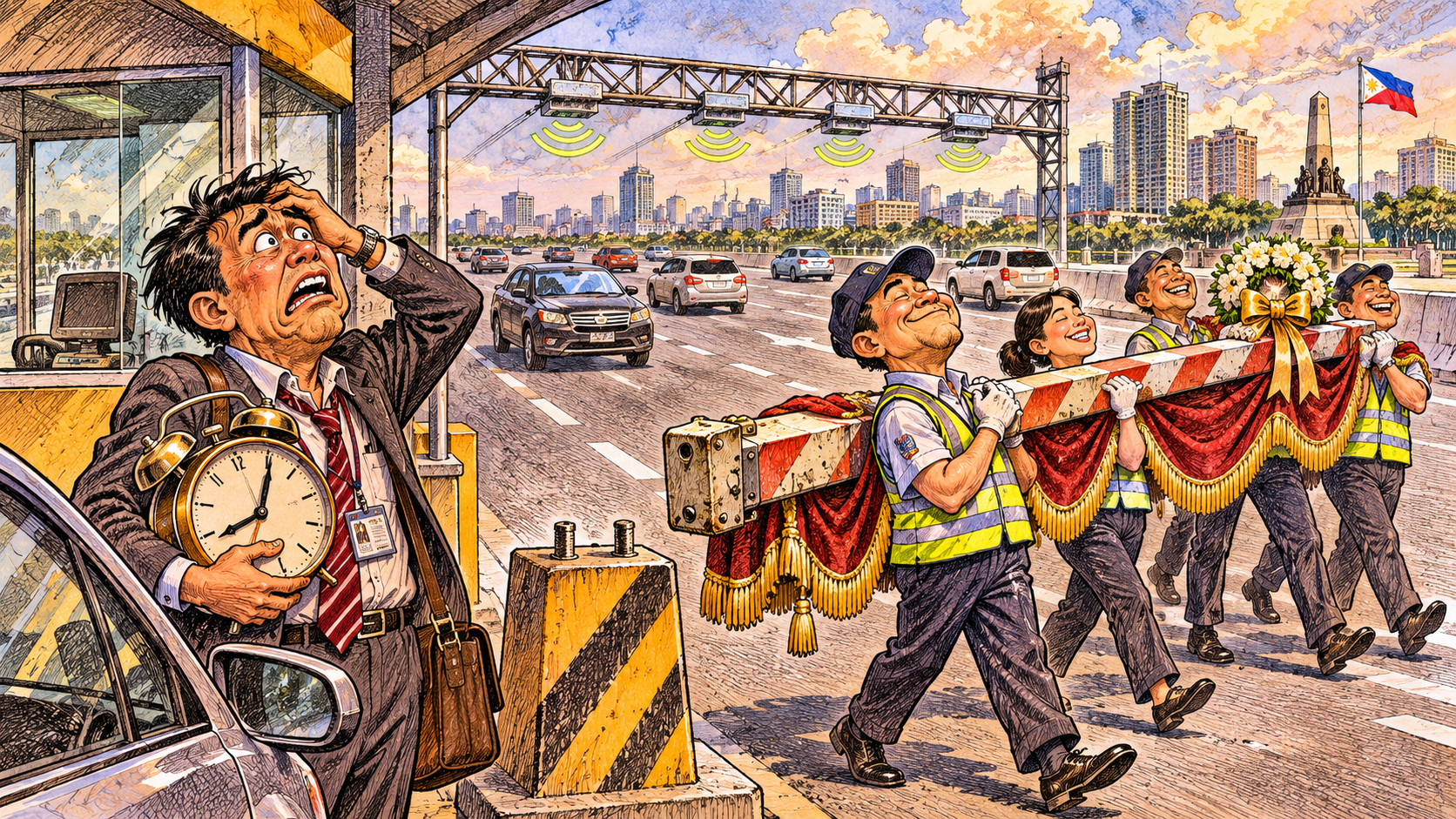
MANILA — Barrierless Tollways have disturbed the country’s most dependable workplace arrangement: the employee who leaves late, the supervisor who suspects it, and the toll barrier that accepts full responsibility without requesting legal representation.
The Department of Transportation is targeting pilot tests of a multi-lane free-flow toll system before year-end. Its proposals require operators to address electronic payments, equipment readiness, and enforcement. According to DOTr’s proposed barrierless tollway pilot, this remains a testing and preparation programme, rather than a declaration that every gate has already vanished.
Barrierless Tollways threaten the national excuse supply
At an emergency meeting of chronically delayed professionals, sales coordinator Jun Mercado placed an old RFID sticker beside a candle. “That barrier stood between me and accountability,” he explained. “Sometimes it stood between me and the office. But mostly accountability.”
His colleagues examined replacement explanations. Rain was seasonal. An unexpected meeting required another person to cooperate. Saying the dog ate the car keys attracted difficult follow-up questions about veterinary invoices. Traffic remained promising, although management had recently discovered map applications.
The committee’s strongest evidence was Jun’s dashboard clock, which recorded his departure eleven minutes after the meeting began. Members immediately classified it as a foreign-funded instrument.
The wallet remains a demanding passenger
Free-flow tolling does not mean free tolls. A motorist still needs to follow the operator’s payment and account rules. Jun considered this disappointing, having interpreted the removal of physical barriers as a broader emotional commitment to generosity.

His RFID wallet has now requested a standing appointment, arguing that it receives less regular attention than his fantasy basketball team. In a household audit, his wife found three charging cables, two expired parking cards, and no persuasive reason he could not check his balance before joining an expressway.
The audit’s sample consisted of one husband. Its findings nevertheless achieved unusually rapid peer review when every wife at the table nodded.
A faster trip creates slower explanations
Transport planners measure throughput: how much traffic passes a point in a period. Office workers measure plausible deniability: how much lateness can pass a supervisor before a calendar invitation appears. Improvements in the first threaten a contraction in the second.
An unobstructed toll plaza could save minutes otherwise spent idling. Jun’s proposed reinvestment strategy allocates those minutes to a coffee queue, followed by a longer discussion of how unexpectedly long the coffee queue was. Economists call this substitution. His supervisor calls it Jun.
Parking volunteers to absorb the surplus
The parking garage has offered reassurance that arrival will never become completely frictionless. Its payment machine is prepared to reject a banknote with the steady moral confidence of a nightclub bouncer inspecting a school ID.
For an actual trip, drivers should check operator announcements, RFID balances, and pilot arrangements before travelling. A proposed system is no reason to assume every lane uses identical rules. Jun has agreed to prepare responsibly, beginning with a detailed list of people who should remind him.
Meanwhile, the retired barrier is being considered for an office position. It has years of experience delaying progress, never answers emails, and can rise dramatically whenever an important person approaches. Human resources says those are excellent management credentials.
Satire disclaimer: Our ceremonial authorship committee comprises two sentient beings—the world’s oldest tenured professor and a philosophy major turned dairy farmer. The toll barrier’s retirement benefits remain under negotiation. Linked reporting supplies the news peg; the office dialogue and comic proceedings are satire.