
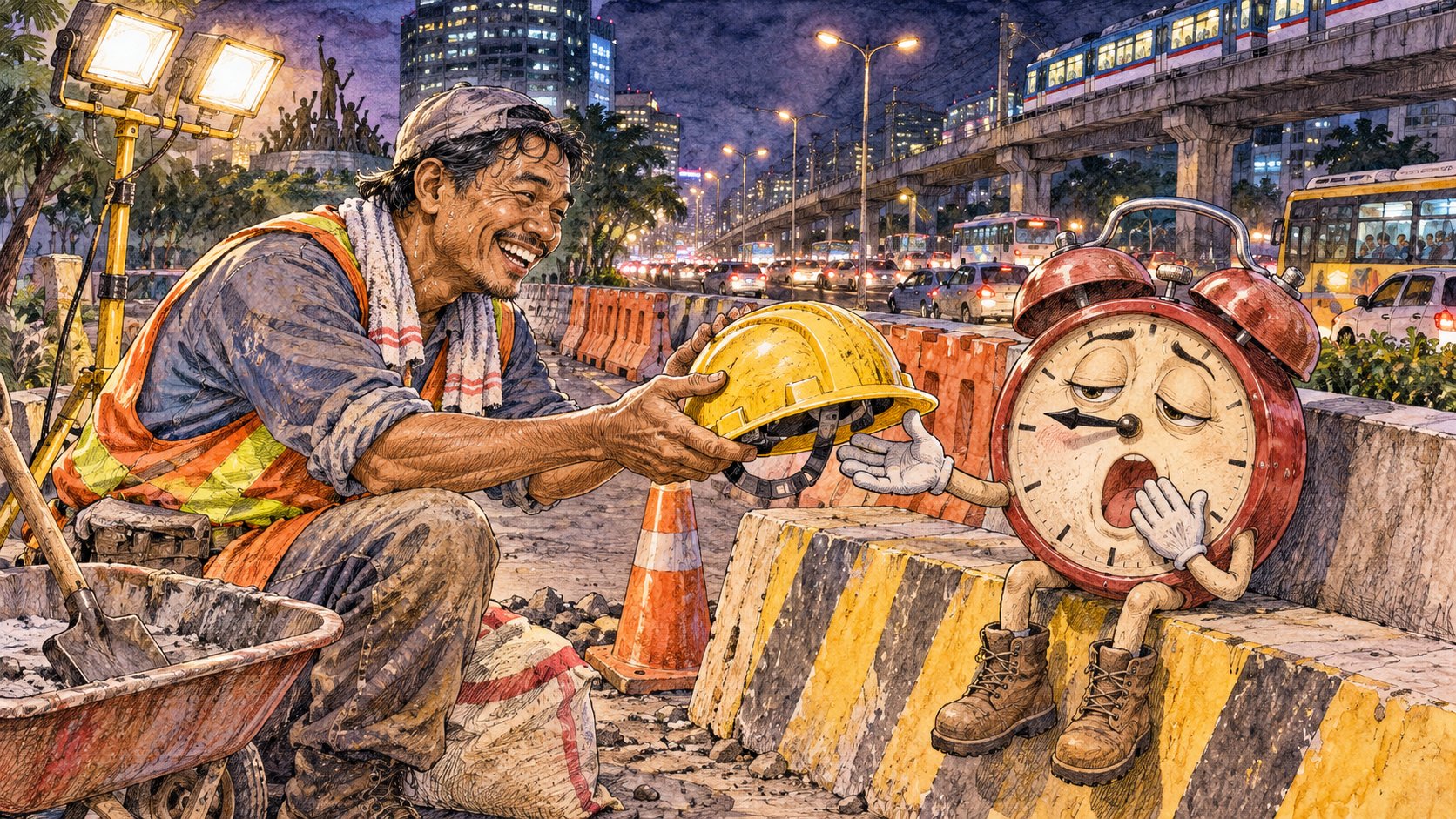
MANDALUYONG — EDSA’s forthcoming night-only roadworks arrangement has prompted commuter Nestor Baluyot to ask whether the traffic has been formally notified of its revised working hours.
The MMDA announced that reblocking and rehabilitation along EDSA would be limited to 10 p.m. until 5 a.m. beginning December 1, suspending daytime roadworks. The change addresses construction scheduling. Baluyot’s appointment book is now waiting to learn whether congestion recognizes the same distinction.
EDSA nighttime roadworks acquire a personnel problem
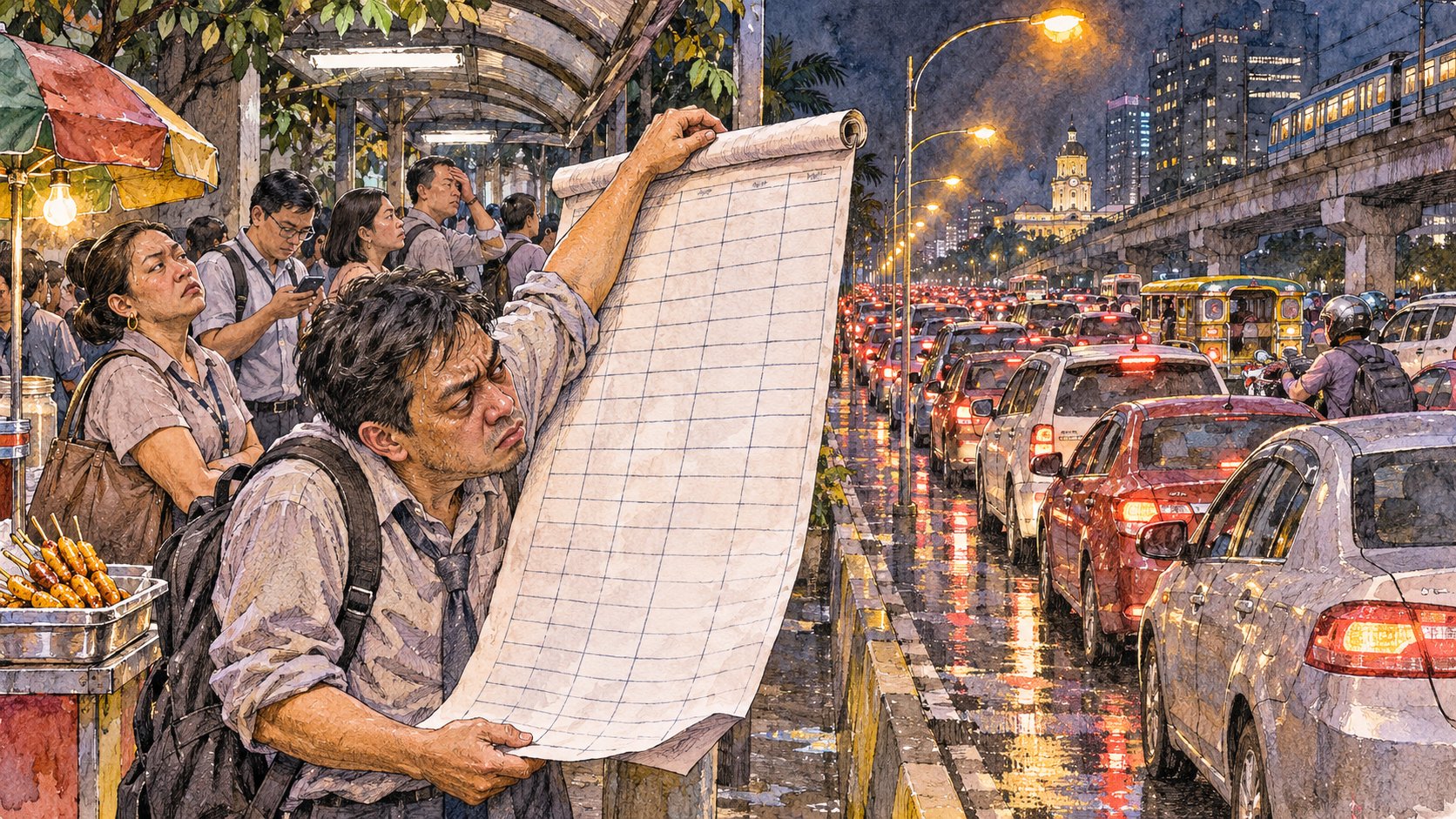
At a Mandaluyong eatery, he spread a handwritten shift roster between a plate of tapsilog and a motorcycle helmet. Construction occupied the night column. Work occupied the day column. His commute had entered both columns without consulting him.
“I support giving road repairs a proper schedule,” he said. “I would also like a schedule for the part where I explain to my supervisor that the schedule happened to me.”
His colleague Lorie proposed treating the journey as a second job. It already required regular attendance, emotional restraint and a packed meal. The only missing employment benefit was compensation, although the vehicle occasionally supplied complimentary lower-back awareness.
Baluyot’s household transport audit found that every trip described as “just along EDSA” eventually required a longer explanation. The audit sampled his last six conversations with his wife, all of which she remembered more accurately than he did.
The roadworks policy does not promise an empty highway, a distinction his office group chat initially struggled to maintain. One colleague interpreted “no daytime roadworks” as permission to leave home later. Another immediately scheduled a breakfast meeting, restoring the original departure time through private-sector initiative.
Commuter requests a timetable for the timetable
Night workers face the reverse calculation. For them, 10 p.m. is less a convenient construction window than the hour when someone asks why they look tired. A bakery employee at the next table suggested that every traffic announcement should include a small portrait of a person who actually travels during it.
Baluyot drafted a polite request for congestion to submit overtime claims in advance. The request included space for purpose, duration and whether the delay could have been handled by email. The form ran out of space before reaching the supervisor’s signature.
At home, his son asked whether the construction workers would sleep during the day. Baluyot said he hoped so. The boy asked whether the road would sleep too. It was the first transport proposal that evening to receive unanimous support.
For now, Baluyot will check official updates, allow room for changing conditions and retain the thermos that has survived three different commuting strategies. He has not surrendered his optimistic departure estimate. He has merely moved it to the night shift, where fewer people can see it.
Source: EDSA nighttime roadworks — reporting and details.
Disclaimer: The linked MMDA schedule is real; Baluyot, Lorie, their dialogue and household audit are invented. This story is entirely a human collaboration between the world’s oldest tenured professor and a philosophy major turned dairy farmer, both requesting overtime for the journey to the punchline.