
MANILA — A maritime education workshop inspired an administrator to ask whether a sufficiently documented filing cabinet could qualify as seaworthy. Cadets responded that they would prefer to begin with a vessel.
The initiative focuses on oversight. PNA’s report on the MARINA–EU-ASEAN workshop describes work on surveillance, accreditation and monitoring of maritime education. Its central point is practical: standards need effective implementation and measurable results. A thick folder should document good training, rather than serve as a flotation device for weak training.
Maritime schools Philippines face the binder test
cadet Nico Watchkeeping has studied the sea long enough to appreciate its unusual administrative style. A wave does not request a letter explaining why someone failed to prepare. It simply arrives.
“In the office, you can ask for another copy,” he said. “At sea, I would rather have the actual skill.”
Nico supports proper records because standards and certification matter. He merely hopes the records continue to correspond with equipment, instruction and competence.
His classmate asked whether an impressive brochure could navigate a ship. The instructor replied that brochures have excellent destinations and limited steering.
Accreditation needs a working engine
Accreditation involves evaluating whether an institution meets relevant requirements. That task becomes useful when monitoring checks what students actually experience and what graduates can do.
An school proposed replacing a practical exercise with a photograph of an exercise. The cadets objected that a photograph of a life ring would be equally convenient and similarly unhelpful in the water.
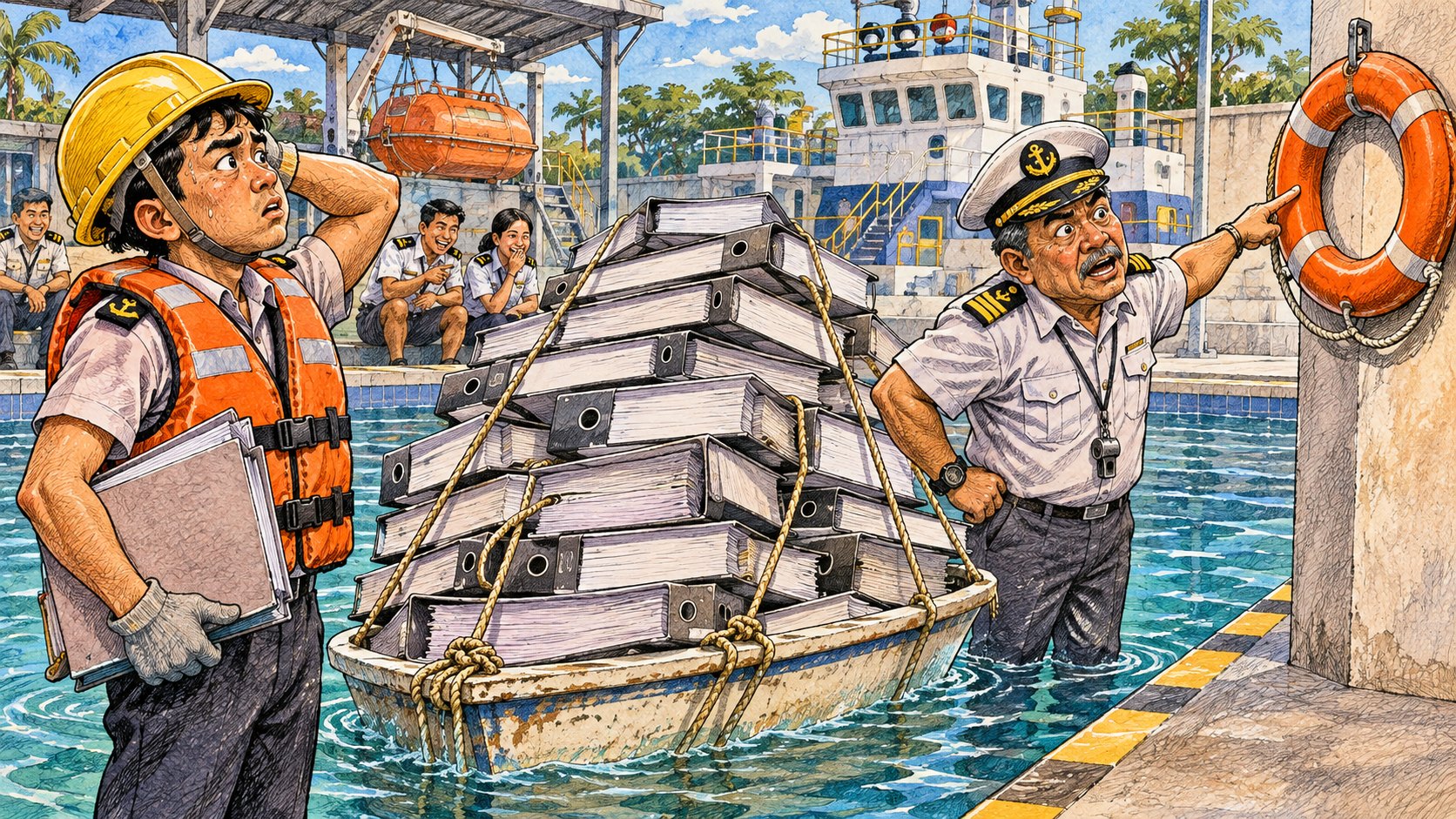
The Manila News Binder Buoyancy Laboratory lowered a stack of compliance folders into a training pool. They absorbed water enthusiastically and demonstrated no independent navigation capability.
The experiment did not assess any real school. It established the narrower principle that stationery should remain in its professional lane.
Standards travel with the graduate
Filipino seafarers deserve preparation that supports their work and confidence in their credentials. Institutions need capable instructors, appropriate facilities and consistent oversight. Students need clear information before committing time and money.
A system can be demanding without making the applicant’s main achievement surviving a scavenger hunt for supporting documents.
Nico’s family understands this. They are proud of his studies and occasionally ask him to explain a ship’s systems while he is trying to eat dinner.
His uncle believes every technical question can be solved by asking whether somebody has tried switching the engine off and on. Nico has begun assigning his uncle to shore-based duties.
The workshop’s emphasis on implementation offered welcome relief from the idea that another declaration automatically produces improvement.
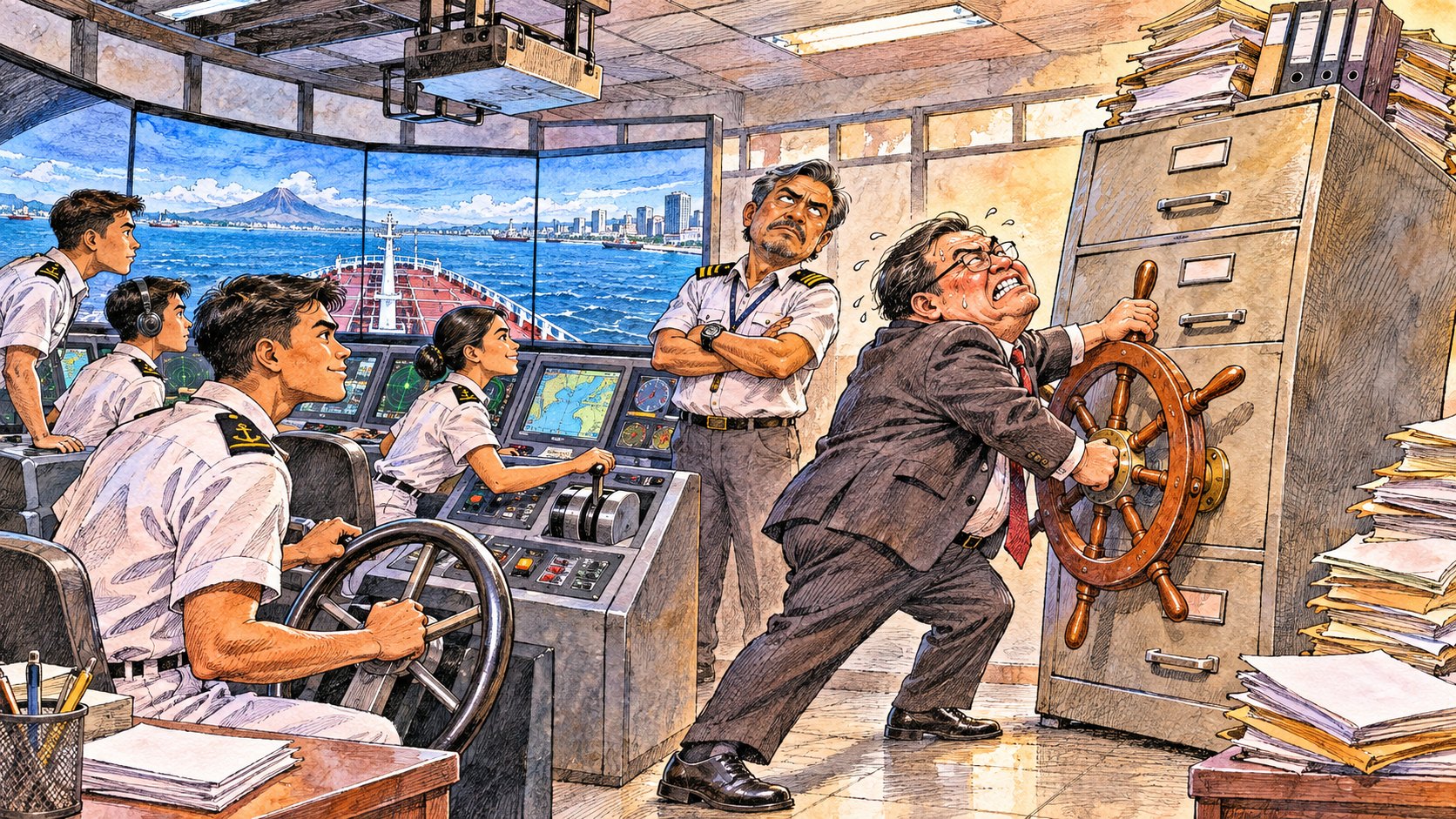
At the closing ceremony, an administrator unveiled a filing cabinet fitted with a ship’s wheel. It had excellent storage capacity and a deeply uncertain future.
Nico inspected it and recommended the safest possible deployment: beside a desk, on land, with the drawers closed.
The instructor approved. It was the first vessel in the exercise to arrive exactly where it belonged.
Editorial disclaimer: No maritime school submitted a filing cabinet for certification. The world’s oldest tenured professor and a philosophy major turned dairy farmer accept responsibility for its unsupported voyage.