
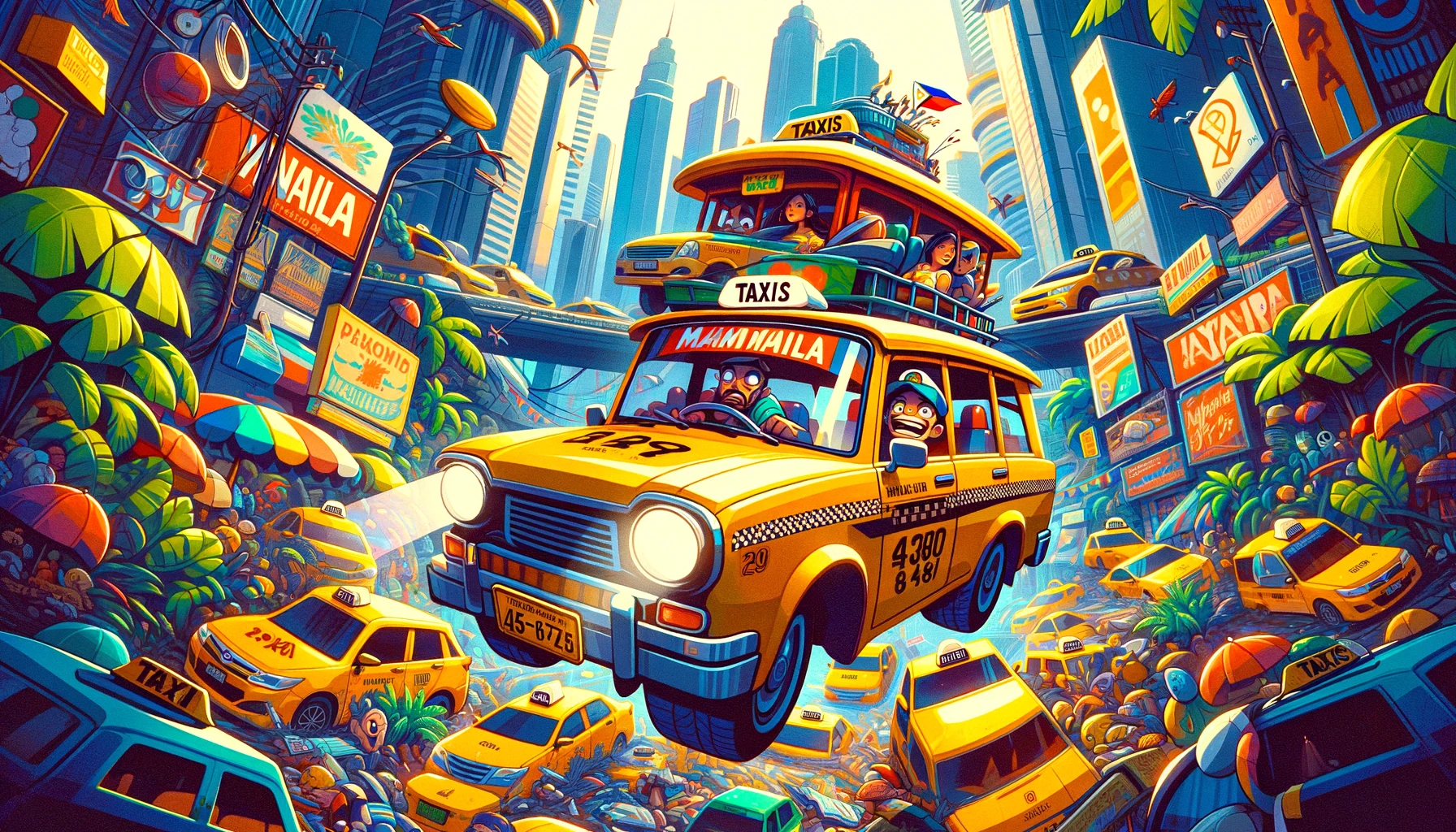
Taxis of Manila: The Vehicles That Play Hard to Get – A Satirical Guide
The Intricate Dance of Manila Taxi Courtship
In Manila’s vibrant tableau, where the cacophony of daily life melds into a melody of chaos and order, the act of hailing a taxi transcends mere transportation—it becomes a narrative of pursuit, of longing, and occasionally, of unfulfilled desires. This dance is not confined to the unassuming streets of Manila alone but resonates through the veins of Quezon City, Makati, and beyond, echoing the universal quest for connection.
The Mysterious Courtship Rituals

In Quezon City, the act of hailing a cab can evoke memories of adolescent yearning, a throwback to days when the object of your affection might just as likely pass you by with nary a glance. According to Dr. Commuta Luv, a renowned sociologist specializing in urban interactions, “The ritual of taxi hailing in Manila is imbued with a complex language of non-verbal cues, mirroring the intricate dance of courtship found in human relationships.” This dance, fraught with anticipation and often disappointment, is a daily ritual for thousands, each participant a silent actor in a citywide play of pursuit and evasion.
Selective Hearing: A Taxi’s Sixth Sense
In the bustling districts of Pasig, this phenomenon of selective engagement is not merely anecdotal. A study by the University of Urban Mobility revealed that Manila taxis exhibit a 82% likelihood of ignoring potential passengers during peak hours, a statistic that bewilders tourists and locals alike. “It’s a curious case of urban adaptation,” notes urban anthropologist Dr. Lane Weaver. “These taxis, through some arcane city wisdom, have developed a discernment ability that rivals that of seasoned diplomats.”
The Art of Rejection: Taxi Style
Mandaluyong’s forlorn commuters know this art all too well. Each nuanced rejection, whether through a subtle nod or a swift acceleration, carries a weight of finality. The “Broken Hearts Club” of Mandaluyong, a support group for the taxi-rejected, reports a diverse membership, a testament to the universality of this experience. “It’s not just about getting somewhere,” says club founder Myla Hartbrkn. “It’s about the rejection, the feeling of not being chosen, that really stings.”
The Chase: Urban Safari
Chasing a taxi in Marikina is akin to engaging in an urban safari, where the quarry is elusive, and the hunter is often left empty-handed. Fitness experts even tout the benefits of this unexpected exercise, citing the “Taxi Dash” as Manila’s inadvertent contribution to public health. Yet, the psychological toll of the chase, the near-misses, and the what-ifs, imbue this activity with a bittersweet tang.
Unrequited Love on Wheels

In Parañaque, tales of near connections and sudden departures abound, painting a narrative of unrequited love that transcends the personal and becomes emblematic of the city’s rhythm. Psychological counselor Dr. Ava Ride posits that “this dynamic mirrors human relationships, where the fear of commitment and the allure of freedom play out on the asphalt stage.”
The Mirage: A Commuter’s Oasis
The mirage of a distant taxi in Caloocan, shimmering in the heat, tantalizes and taunts. It’s a phenomenon that speaks to the heart of human hope and resilience. “Our desire for the taxi is a microcosm of our larger yearnings,” observes philosopher Dr. Thaddeus Miles, “a reminder of our perpetual chase after what seems just within reach, yet remains elusive.”
Playing Hard to Get: The Ultimate Strategy
The strategy of scarcity employed by Manila’s taxis, whether intentional or coincidental, stokes the flames of desire. “In creating a sense of unattainability, these taxis inadvertently elevate their desirability,” explains marketing guru Dr. Chase Demand. “It’s a lesson in supply and demand, played out on the unpredictable streets of Taguig.”
The Matchmaker: When Stars Align
On those rare occasions when the universe conspires to connect passenger and taxi in a seamless ballet, the streets of Taguig become a backdrop for serendipity. These moments, while fleeting, are celebrated as minor miracles, a cosmic alignment in the chaos of urban life. “It’s a reminder,” says astrologist Luna Destino, “that even in the most unexpected places, there’s room for magic and connection.”
Ghosting: A Modern-Day Tragedy
Valenzuela’s streets bear witness to the modern tragedy of ghosting, where taxis, like fleeting shadows, promise engagement only to disappear into the throng. This act, reflective of contemporary dating woes, resonates with a generation accustomed to transient connections. “The taxi’s departure is not just a missed ride; it’s a metaphor for the ephemeral nature of our interactions in a hyper-connected world,” notes Dr. Neil Abandon, a psychologist specializing in digital relationships.

Originally posted 2024-03-28 03:34:15.