

MANILA — A court interpreter has asked a legal sentence to identify its main point voluntarily after the sentence entered its fourth qualifying clause without establishing where the listener should stand.
The Supreme Court has reaffirmed the importance of court interpreters in making justice accessible, including for people who do not speak the court’s language and Deaf Filipinos. Interpreter Elena Macaraig believes that access is improved further when the sentence itself stops guarding the entrance.
Court interpreters in the Philippines meet the extended sentence
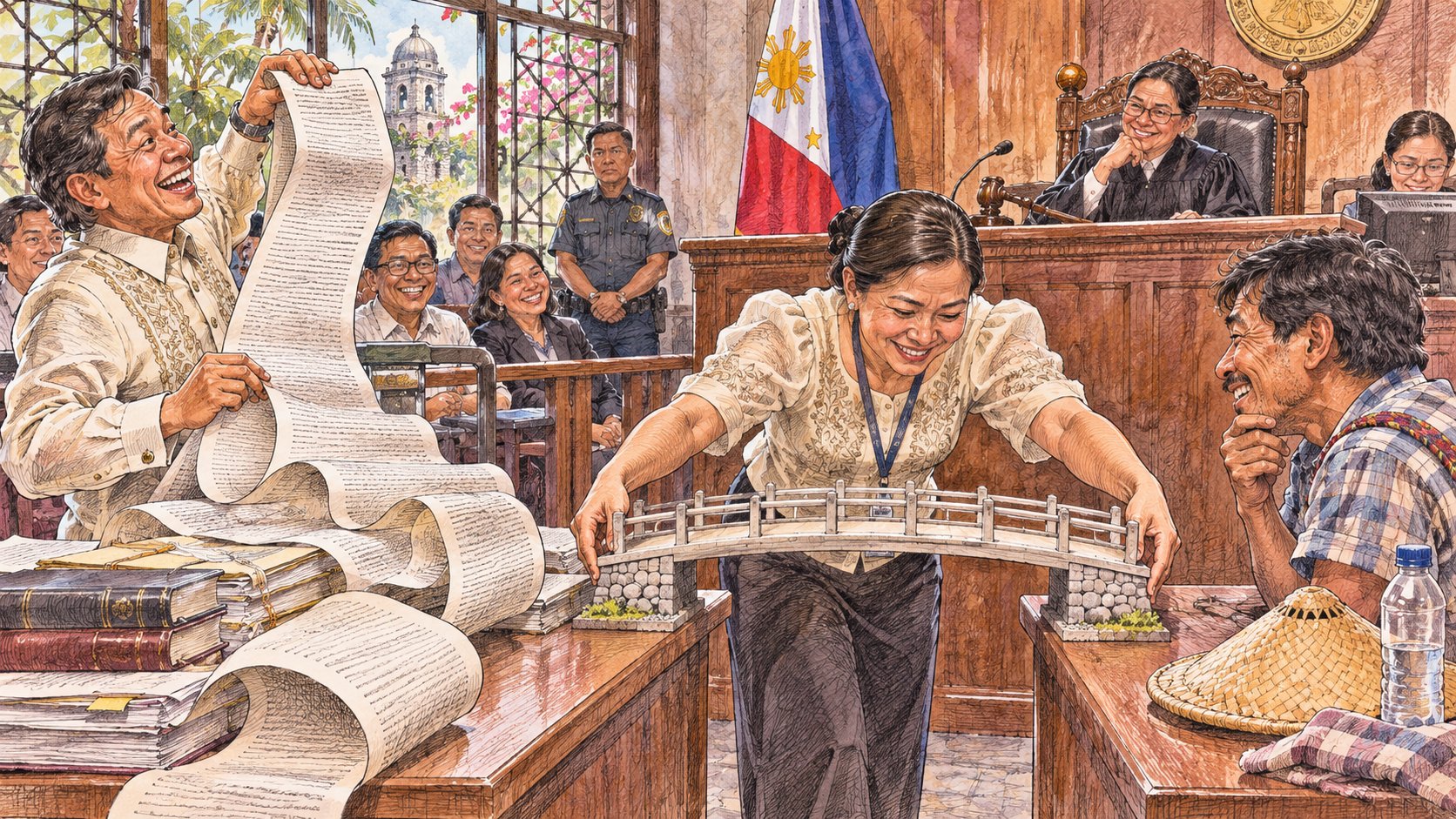
At her practice desk, Macaraig laid a long paper ribbon between two chairs. One chair represented a person asking a straightforward question. The other represented a person who deserved to understand the answer. The ribbon represented the journey legal prose had chosen between them.
“I can carry the meaning across,” she said. “It helps if the meaning comes to the departure point.” A colleague checked the far end of the paper for a missing verb.
Macaraig’s exercise concerned professional clarity, not the intelligence of the listener. A person can understand a difficult situation perfectly well and still need assistance with a sentence that appears to have been assembled by several committees avoiding eye contact.
Her practice log listed expressions that could be made shorter without losing their purpose. “At this point in time” became “now.” The liberated time was then available for the actual question. The log treated this as a small but repeatable improvement in public service.
A trainee suggested that a longer phrase might sound more authoritative. Macaraig asked him to request a glass of water using the longest available wording. He completed the request after the water had become less cold. The demonstration was entered under practical consequences.
The main verb is invited to come forward
Interpreting requires attention, judgment and fidelity to meaning. It is not a license to improve somebody’s evidence or substitute a more convenient answer. Macaraig marked this distinction on the practice table, where it occupied much less room than the sentence still traveling across it.
The colleague returned with the main verb. It had been waiting behind “without prejudice to the foregoing,” maintaining a low profile. Macaraig placed it beside the subject. The sentence immediately became more useful without acquiring any new furniture.
A short bridge model completed the exercise. Its purpose was obvious: people on one side should be able to reach the other. The trainee asked whether the bridge needed a ceremonial name. Macaraig said it first needed to work.
By the end of the session, the paper ribbon had been folded into a manageable stack. No legal right had been removed to make it fit. The listener’s chair could finally be moved closer to the answer, which Macaraig regarded as the most defensible rearrangement in the room.
Source: court interpreters Philippines — reporting and details.
Disclaimer: The linked Supreme Court statement is real; Macaraig, the trainee and their language exercises are invented. This story is entirely a human collaboration between the world’s oldest tenured professor and a philosophy major turned dairy farmer, who have located the verb and are arranging its safe return.