
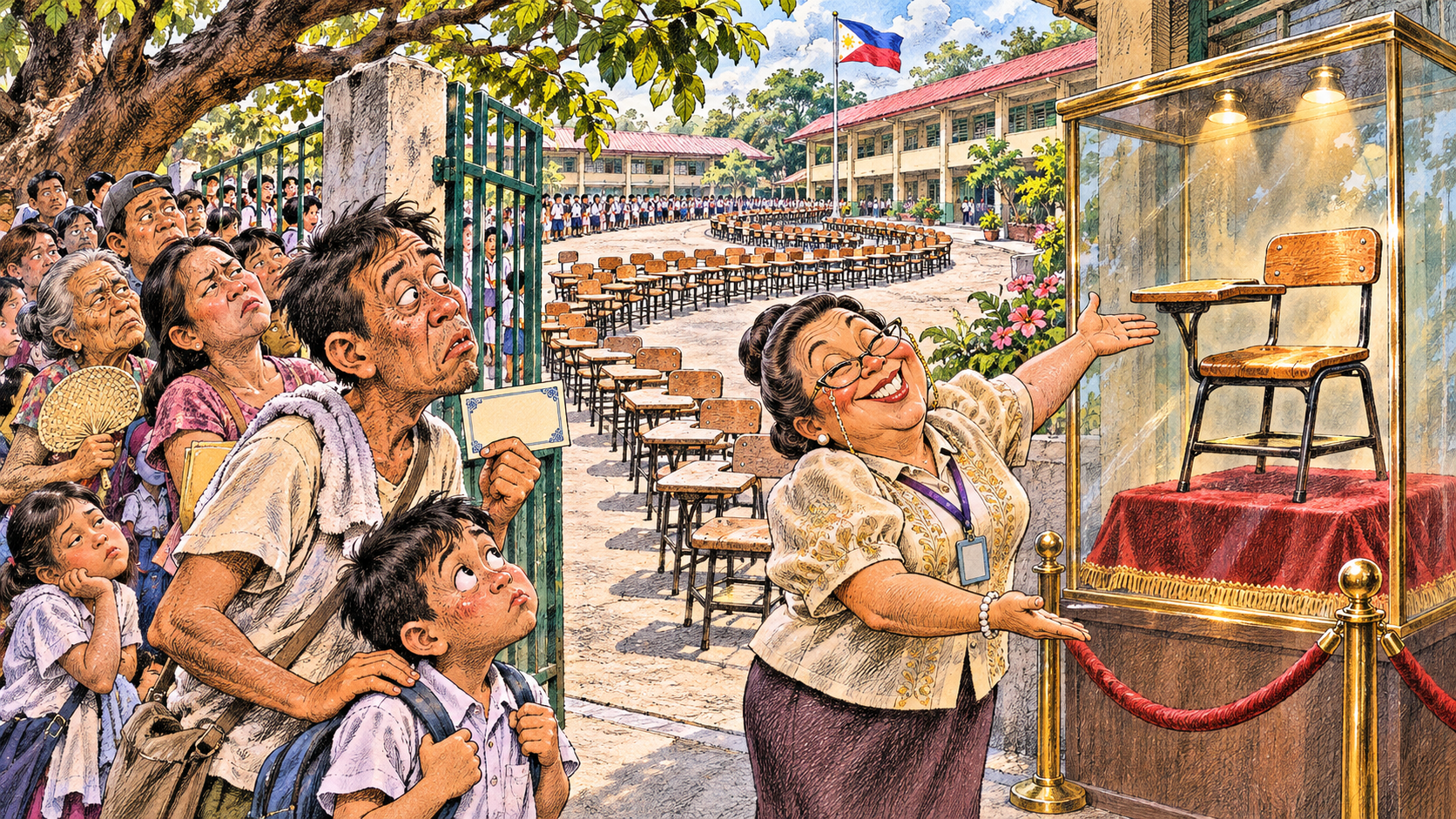
The basic education voucher law has encouraged Filipino parents to consider a wider range of schools, while one mother has asked whether the available choices can be filtered by the radical criterion “has somewhere for the child to sit.”
Mila approached school choice with a notebook, a calculator, and the expression of someone comparing internet plans whose promotional prices all concealed a staircase. Her son Paolo asked whether choosing a school also allowed him to choose a shorter Monday.
Basic education voucher meets the available desk
EDCOM 2 says the newly signed Basic Education Voucher Assistance Act extends assistance across basic education and prioritizes learners facing congestion and other access barriers. Implementation depends on the law’s rules and funding. EDCOM 2’s explanation of the voucher law sets out eligibility, quality safeguards, and the staged rollout.
Mila welcomed the prospect of support. She had no philosophical objection to choice. She simply wanted to know whether it included tuition, transportation, uniforms, and the small daily expense of keeping a growing child from consuming his entire allowance before the first lesson.
An enthusiastic relative recommended the school with the best brochure. Mila observed that the brochure’s children appeared to have three meters of personal space each. Paolo asked whether the wide-angle lens could be included in the voucher.
The family develops a route-based education policy
The kitchen table became a planning office. Toy jeepneys represented transport links, teaspoons represented walking distances, and a large saucepan represented the intersection that swallowed every optimistic estimate. A school that looked close on the map moved two hours away when the saucepan was introduced.

Her husband suggested the nearest option. Mila pointed out that “nearest” had three meanings: nearest in kilometers, nearest in travel time, and nearest to what the household could pay after every other expense had finished explaining itself.
Paolo selected the school with the biggest basketball court. This was rejected as an incomplete assessment, although his father conceded that it was more concrete than the phrase “future-ready excellence,” which appeared in every prospectus and could apparently describe a chair.
School choice requires information people can use
Mila wanted clear eligibility guidance, published costs, reliable quality information, and notice of when applications would actually open. She did not want a forwarded message promising a guaranteed subsidy in return for sending personal documents to somebody’s nephew.
Teachers in the neighborhood welcomed any policy that could reduce overcrowding without treating education as a seat-swapping exercise. A child needs instruction, support, and continuity, they said, rather than simply a new place to stand while adults congratulate the seating plan.
Mila prepared questions for the relevant schools and waited for official implementation details before promising Paolo a transfer. He asked whether the new bureau would process homework complaints. She explained that its mandate was broader. He said his complaint was also broad.
At the end of the exercise, the family had a shortlist, several realistic budgets, and a toy jeepney permanently trapped beneath the saucepan. Mila called it progress: they had finally produced an education plan that acknowledged the commute.
Disclaimer: This classroom satire is a human collaboration between two sentient beings—the world’s oldest tenured professor and a philosophy major turned dairy farmer. The saucepan is not an accredited transport consultant.