

Setting the Sardonic Seascape: West Philippine Sea
The South China Sea: Where Sovereignty is a Punchline and Diplomacy is Slapstick
Scarborough Shoal, West Philippine Sea — Tired of predictable political dramas? The West Philippine Sea, or as seasoned observers call it, “The South China Sea Comedy Hour”, offers non-stop geopolitical absurdity that makes reality TV look like a parliamentary debate.
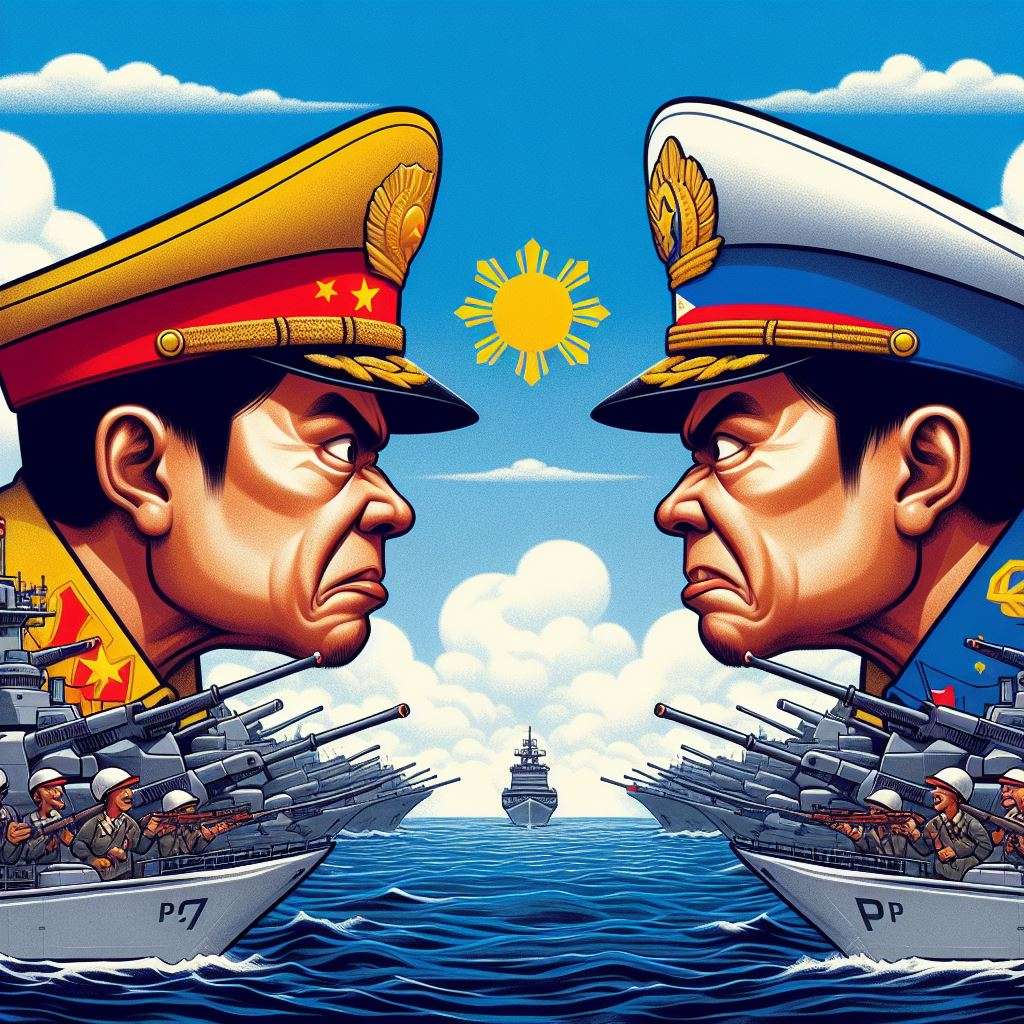
This contested body of water isn’t just about strategic resources; it’s the world’s stage for the clash of tragically bloated egos and baffling diplomatic maneuvers. Let’s meet our players:
- China: The Aggressive Newcomer This rising stand-up giant uses island-building and naval flexing to deliver a set focused on “historical ownership.” Their jokes may be old, but their delivery is forceful enough to get begrudging laughs.
- The Philippines: The Scrappy Underdog Their set relies heavily on international law punchlines, delivered with a mix of defiance and exasperation. It’s a crowd favorite, but the impact on the headliner is debatable.
- The United States: The Fading Headliner America’s act centers on “freedom of navigation” and stern warnings, but their routine feels tired. Still, they have the biggest mic (and navy), so they can’t be ignored.
- The Supporting Cast Countries like Vietnam and Malaysia try to squeeze in their own sets, while ASEAN attempts to wrangle this dysfunctional comedy troupe with the effectiveness of a wet noodle.
The show’s signature bit? The annual “You bumped my boat!” routine, featuring close-call naval encounters and strongly-worded press releases that achieve absolutely nothing.
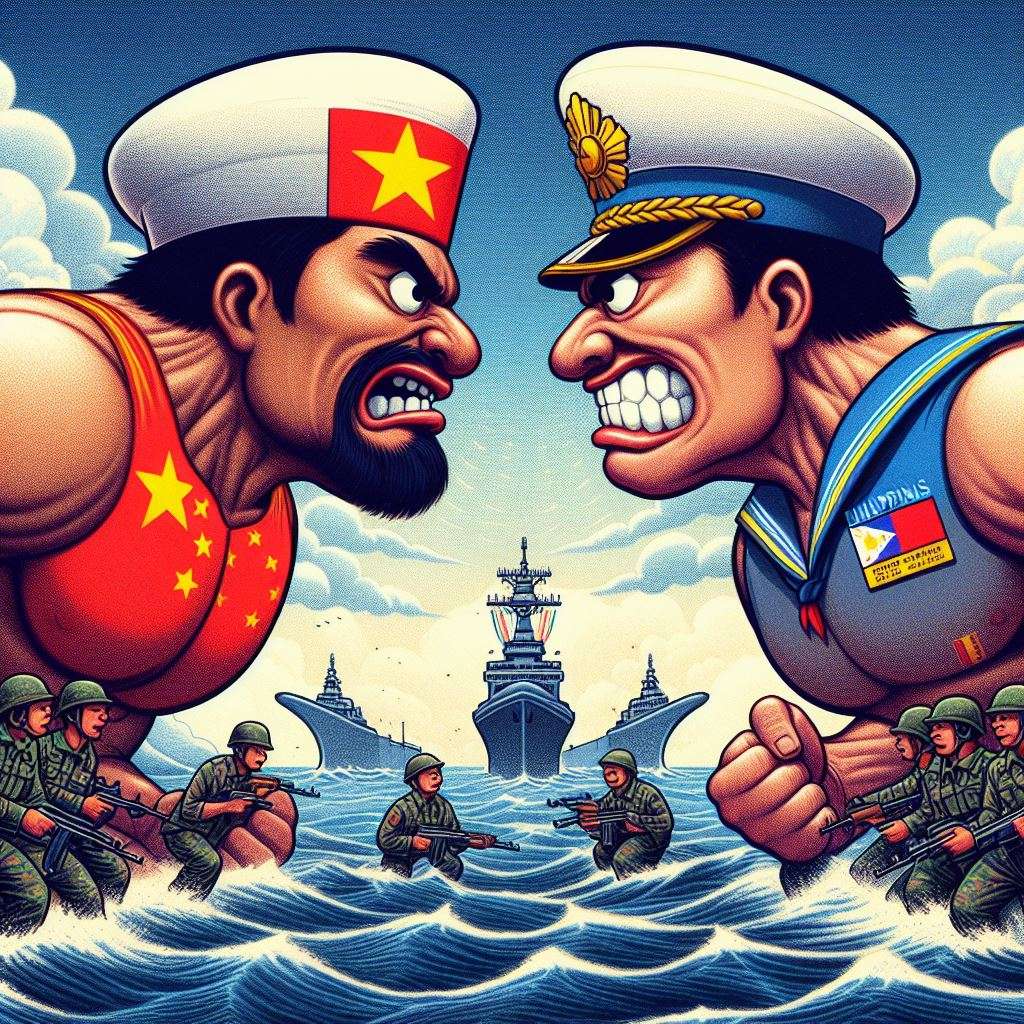
Critics denounce the whole spectacle as dangerous and unproductive, but hey, it’s better entertainment than most UN summits. Tensions simmer, punchlines get recycled, and any hope of a genuine resolution seems to drown amidst the absurdity.
Behind the Laughter: A Tragic Backstage
It’s important to remember that while the South China Sea conflict makes for darkly comedic satire, there are real consequences. Fishermen lose livelihoods, tensions escalate dangerously, and the delicate balance of power shifts with every reclaimed reef and diplomatic stumble.
Perhaps the biggest joke is that with some genuine cooperation and respect for international law, this maritime hotspot could be a place of shared prosperity rather than a geopolitical clown show. But, as any comedian knows, punchlines are easier than solutions, and the audience always loves a good spectacle.
An In-Depth Investigation into the West Philippine Sea Fiasco
Manila, Philippines — Roll up your sleeves, dear readers, and adjust your snorkels. We’re about to plunge into the West Philippine Sea, the comedy club of maritime politics, where nations perform their stand-up routines on disputed reefs and shoals. But this isn’t your average open-mic night. Picture this: a cerulean-blue stage set with natural gas and fish stocks, while in the audience, a smorgasbord of claimant countries heckle each other, not with tomatoes, but with naval vessels and fishing fleets. Ah, the drama of international waters, where the only thing deeper than the ocean is the sarcasm it inspires.

Let’s set the scene for our satirical swim. To the West Philippine Sea’s north, there’s the South China Sea—a misnomer because it should technically be named the ‘South of China But Not Exclusively Chinese Sea,’ according to anyone with an atlas and a sense of fairness. Yet, in a cartographical twist straight out of a geography teacher’s fever dream, we find the ‘nine-dash line,’ a doodle drawn by China’s cartographic comedians, encompassing an area generously sliced like a cake they forgot to invite the other claimants to share.
Now, if you ever stumble upon a historical document in a sunken ship down there, chances are it’s a map from the Philippines, Brunei, Malaysia, Taiwan, or Vietnam, each trying to prove their ancestral fishermen were the first to Instagram their catch of the day in these disputed waters. And then there’s the International Court of Justice, waving its 2016 ruling that China’s maritime claims were as sustainable as a chocolate teapot, a legal pronouncement with about as much heft in Beijing as a karaoke ban.
What’s the big deal, you may ask? Well, beneath the waves lies a veritable treasure trove of resources, and atop it, a highway for half of the world’s shipping traffic. It’s like discovering that your backyard not only has oil but is also the shortcut for every Amazon delivery drone. Control the West Philippine Sea, and you control a vital jugular of global trade.
The squabble over this stretch of sea is filled with enough intrigue and farce to fuel a season of ‘Game of Thrones’—if George R.R. Martin traded dragons for destroyers and had a penchant for pun-filled legislation. With a wry smile, we embark upon a journey to parse through the melee with the same seriousness as a beauty pageant Q&A round. Expect a flotilla of sarcasm and a medley of maritime mirth as we navigate the choppy waters of geopolitical gags and oceanic one-liners.
Now, hold fast to your floaties as we embark on a voyage through the whimsical waves of the West Philippine Sea. It’s a tale that’s less ‘Odyssey’ and more ‘Oh dear, they did what?’ with a cast of characters that would send Homer—or at least the Simpsons version—into a Homeric fit of laughter. So, welcome aboard, intrepid humor enthusiasts, to the geopolitical equivalent of a pool party hosted by rival neighborhood associations. It’s splashy, it’s brash, and it promises a whale of a time.
Dissecting the Disclaimer
Before we don our captain’s hats and set sail through this sea of geopolitical japes and jests, let’s first anchor down a little disclaimer. It’s like the lifeguard’s whistle before a belly-flop competition: it gets your attention and sets the stage for the splashy spectacle to come.
So, here it is, our disclaimer, wrapped in seaweed and served on a bed of saltiness: while the waters of the West Philippine Sea may churn with the tension of a thousand diplomats’ furrowed brows, our coverage is infused with the levity of a thousand jesters’ twinkling eyes. Yes, dear reader, this is satire – the art of poking fun at reality so as not to weep at its absurdity.

Consider this article as you would an inflatable pool unicorn – not to be taken too seriously, but capable of supporting you through waves of information. We aim not to trivialize but to texturize, layering the dense and often stodgy geopolitical discourse with a whipped topping of humor that might otherwise be as dry as a sandbar at low tide.
Let’s be clear as the azure waters claimed by every Tom, Dick, and Harry (and Xi and Rodrigo): our quips are crafted not to belittle the importance of the West Philippine Sea, but to make digesting its complex developments less of a chore and more of a choice snack. Think of our words as the sprinkles on the doughnut of discourse, colorful and maybe a bit unnecessary, but making the whole thing far more appetizing.
It’s important to note – and we say this with the wink of a veteran sailor who’s seen one too many squalls – that all nations, leaders, and maritime laws mentioned herein are done so with the nudge-nudge, know-know of a cabaret MC. The facts are as solid as the hull of an aircraft carrier, but our take on them is as slippery as an eel in an oil spill.
We’re not here to chart a course through international law or to solve sovereignty disputes with a swish of a pen. Instead, we’re circling the atoll of the situation, pointing out the often overlooked hilarity that emerges when national egos inflate faster than a life raft.
In essence, prepare to navigate through satire’s tricky straits, where hyperbole and metaphor frolic with the abandon of dolphins in a tuna-free zone. Our barbs and jests are done in the spirit of good fun, like a well-intentioned sea shanty that gets a bit cheeky after the third chorus.
And for our youthful readers – those digital natives who can tweet a witticism before most of us have figured out our coffee machine’s newfangled settings – remember: this is but a jesting lens on the world, a smartphone filter that adds dog ears and snouts to the solemn faces of statesmanship.
Take what follows as you would advice from a wise-cracking parrot perched upon a pirate’s shoulder: a grain of truth salted with good humor. And should any content seem to skim close to the winds of derision, rest assured, it’s all in the name of lampooning the ludicrous, spotlighting the silly, and navigating the nonsense that is so often politics at sea.
Now, let’s weigh anchor and hoist the mainsail. There’s a storm of satire to be sailed, and we’ve got the conch of comedy to guide us through the West Philippine Sea’s vibrant swells.
Navigating National Narratives
As we sail from the disclaimers to the deeper waters, let us now navigate the frothy foam of national narratives in the West Philippine Sea. Here, each country partakes in the diplomatic equivalent of a comedy roast, where everyone’s a bit of a jokester, whether they know it or not.
China: The Nine-Dash Line Stand-Up Act

First to take the mic is China, with its Nine-Dash Line, which, let’s face it, looks like it was plotted by a dragon with hiccups. Beijing’s claims are less ‘historically grounded’ and more ‘creatively buoyant.’ Picture this: a Chinese official stands before the UN, unfurls a map and proclaims, “Here be dragons… and by dragons, we mean our indisputable sovereignty!” You have to admire the bluster; it’s like claiming dibs on the moon because your ancient mythology mentions a rabbit living there.
Quoting a Chinese foreign ministry spokesperson, “The islands in the South China Sea have been China’s territory since ancient times.” One could only wish that playground rules applied to international law. “Finders, keepers” would simplify matters, but alas, international waters aren’t swayed by ancient fairytales, no matter how confidently told.
Philippines: The David-vs-Goliath Dramedy
Then, we have the Philippines, playing the role of David to China’s Goliath, only with less sling and more legal wrangling. Manila waves around the 2016 arbitral ruling like a winning bingo card, except China’s not playing the game. The Philippine narrative is a heartfelt underdog story with a script penned by international law. It’s as if they’re shouting into a typhoon, “Look, we have this piece of paper here that says…” but by the time they’ve finished their sentence, the document’s blown away, and everyone’s back to square one.
The quip that encapsulates the Filipino perspective might well be from their own Department of Foreign Affairs: “We continue to assert our sovereignty and sovereign rights, but we are no match to the Chinese navy.” A sobering thought, injected with a dose of reality. The Philippines’ tale is one of perseverance, like a karaoke session that lasts all night, hoping the neighbors will eventually sing along.
Vietnam: The Bold and the Boundless
Vietnam, meanwhile, is the feisty contender in this oceanic opus, their narrative infused with a ‘won’t back down’ attitude that could inspire a Rocky montage. They’ve been tangling with Chinese vessels like it’s a maritime dance-off, and the South China Sea’s their ballroom. Hanoi’s statement rings loud: “Vietnam has full legal grounds and historical evidence to assert its sovereignty.” That’s the spirit—why let China be the only one with a historical mixtape?
Malaysia: The Claim Whisperers
Now let’s turn to Malaysia, whose claims sometimes come across as whispers in the territorial thunderstorm. They aren’t the loudest at the dispute party, but when they chime in, it’s with a politeness that’s almost…British. “We quietly assert our presence,” seems to be their motto, playing the long game and waiting for the other guests to tire out. It’s as if they’re saying, “Let’s discuss this over tea… which, by the way, is from our territorial waters.”
Brunei: The Silent Submariner
Brunei, for its part, prefers the submarine approach to its claims—submerged and out of the spotlight. They occasionally periscope up to remind everyone, “We’re here too,” with the subtlety of an introvert at a rave. One could imagine a Bruneian diplomat whispering, “Our claim is legit,” before blending into the UN wallpaper.
Taiwan: The Identity Conundrum
And of course, we can’t forget Taiwan, who’s stuck in a geopolitical ‘Who’s on First?’ comedy sketch. Their claim is less about the sea and more about asserting, “We’re also a country!” To which China retorts with a “No, you’re not!” fit for a Monty Python sketch. Amidst the identity confusion, Taiwan’s stance on the South China Sea is like a mystery wrapped in an enigma, shrouded in a puff of smoke from a magician’s cloak.
United States: The Offshore Onlookers
Across the Pacific, the United States watches this maritime melodrama with popcorn in hand, occasionally sending a fleet to remind everyone that ‘freedom of navigation’ isn’t just a catchy slogan. It’s like your neighbor passive-aggressively trimming their hedge while you argue with your family in the front yard; they’re not involved, but oh, they’re making a statement.
The ASEAN Ensemble: The Chorus of Concern
Lastly, there’s the ASEAN ensemble, a chorus of concern harmonizing on the tune of “Can we all just get along?” Their unified message often gets drowned out by the solo acts, but their group number is key to the grand finale.
Each nation’s story, then, becomes a thread in the rich tapestry of the West Philippine Sea saga, woven with the yarns of diplomacy, spun with satire. We see a multiverse of maps that would make cartographers cringe and rhetoric that swings from stately to slapstick. The narratives intermingle, like a family reunion where everyone’s brought their own potato salad recipe and insists it’s the original.
But let’s not dawdle in these waters too long, for there are more satirical seas to chart. Onwards, to the cartographical comedy that awaits – where lines are drawn in the water, and they might as well be doodles.
The Cartographical Comedy
Moving on from the high seas of hyperbole, we drop anchor at the Cartographical Comedy: the West Philippine Sea, where ‘X’ marks the spot of contention and ‘Here be dragons’ is a legal argument.
Imagine a world where cartographers double as comedians, and their maps of the West Philippine Sea look like the sketches of a five-year-old set loose with a box of Crayolas. These maps are less about precision and more about ambition, where each country draws lines in the sand—or, more accurately, in the water—with all the assertiveness of a toddler claiming the entire sandbox because his bucket touched it first.

China, the jolly giant of the sea, is seen sporting a map where the notorious Nine-Dash Line is less a demarcation of territorial limits and more a freeform jazz improvisation. The dashes could easily be confused for the score of a musical number aptly titled “The Ballad of Maritime Ambiguity.” You half expect to find an addendum written in fine print: “And anywhere our ships can reach on a good day.”
The Philippines, in their illustrative retort, offer a map that highlights their Economic Exclusion Zone with all the subtlety of a neon sign at a street fair. It’s a vibrant splash of color that screams, “This is ours!” complete with historical footnotes that might as well include “because we said so” and a sketch of the arbitral ruling blown up to billboard size, just in case anyone missed it the first time.
Vietnam’s map, by contrast, is dotted with oil rigs and coast guard vessels, their way of saying, “We’re not just drawing lines; we’re drilling them!” Theirs is a cartography of conviction, portraying ownership by occupation and picturing a sea speckled with as many drilling platforms as a teenager’s face has pimples.
Malaysia’s map is discreet, elegant, with claims whispered along curving contours that say “Pardon me, but isn’t this ours?” It features dotted lines that seem to politely suggest boundaries rather than shout them, like a butler discretely pointing out which fork to use at dinner.
Brunei, always the wallflower in this maritime dance, showcases a minimalist map with just a small circle demarcating its claim—a modest bubble in a sea of extravagance. It’s the “less is more” approach to territorial assertion, evoking an almost Zen-like calm amid the surrounding squabbles.
Taiwan’s map is an MC Escher-esque conundrum, overlapping with China’s to the point of confusion, a testament to the complex question of their identity. The image is almost a visual puzzle, requiring three-dimensional thinking and possibly a magic eye to interpret.
Not to be outdone, the United States presents a map with freedom of navigation routes highlighted like the yellow brick road, a maritime Oz where American ships can sail under the banner of liberty. The US Navy’s path is so well-traveled it could double as a recommended cruise route, complete with scenic views of disputed islands.
In the corner, almost as an afterthought, ASEAN’s map is a collective patchwork quilt, with each nation’s claims stitched together in an intricate pattern of cooperation and conflict—a tessellation of territorial ambitions that could either cover a bed or be hung on a wall as art.
These fanciful maps provide less clarity and more chuckle-inducing confusion. Each one is like a snowflake—unique and, upon closer scrutiny, completely unsuitable for navigation. It’s as if the countries have agreed to disagree in the most disagreeable manner possible, through the medium of artistic cartography.
In this atmosphere, where the rules of mapping seem to be “anything goes,” one can only expect the charts to evolve. Perhaps the next iteration will involve pop-up features or a scratch-and-sniff function for added sensory engagement. After all, in the West Philippine Sea’s cartographical charade, reality is merely an inconvenience that can be smudged away with the swipe of an eraser or the judicious application of glitter glue.
These maps, with their aspirational borders and contentious contours, are the satirical heart of the region’s territorial debates. They represent the dreams and dramas of nations vying for a space on the maritime stage, each with a vision of the sea that’s as much about national narrative as it is about navigational accuracy. The West Philippine Sea doesn’t just challenge the sailors’ skills; it challenges the cartographers’ creativity, inviting them to partake in an oceanic origami exercise where every fold is a political statement and every crease a claim.
With our compasses confounded and our GPS systems giggling, we acknowledge the bizarre beauty of these not-so-accurate atlases. It’s a reminder that when it comes to the West Philippine Sea, the map is not the territory—it’s a punchline.
Quoting the Quirky Quips
In the grand maritime pantomime that is the West Philippine Sea dispute, our chorus line of officials has not disappointed, offering up quotes that sparkle with the wit of a sea cucumber. In this theater of the absurd, where every diplomat seems to moonlight as a stand-up comedian, let’s take front-row seats and enjoy some of the quirkier takes on maritime diplomacy.
One official, when asked about the impact of artificial islands in the sea, quipped, “Well, I guess we now have more options for beachfront property – if you don’t mind your neighbor’s flag being a bit… imposing.” The remark sailed close to the wind, capturing the mood of jesting jesters jesting on the decks of this geopolitical galleon.
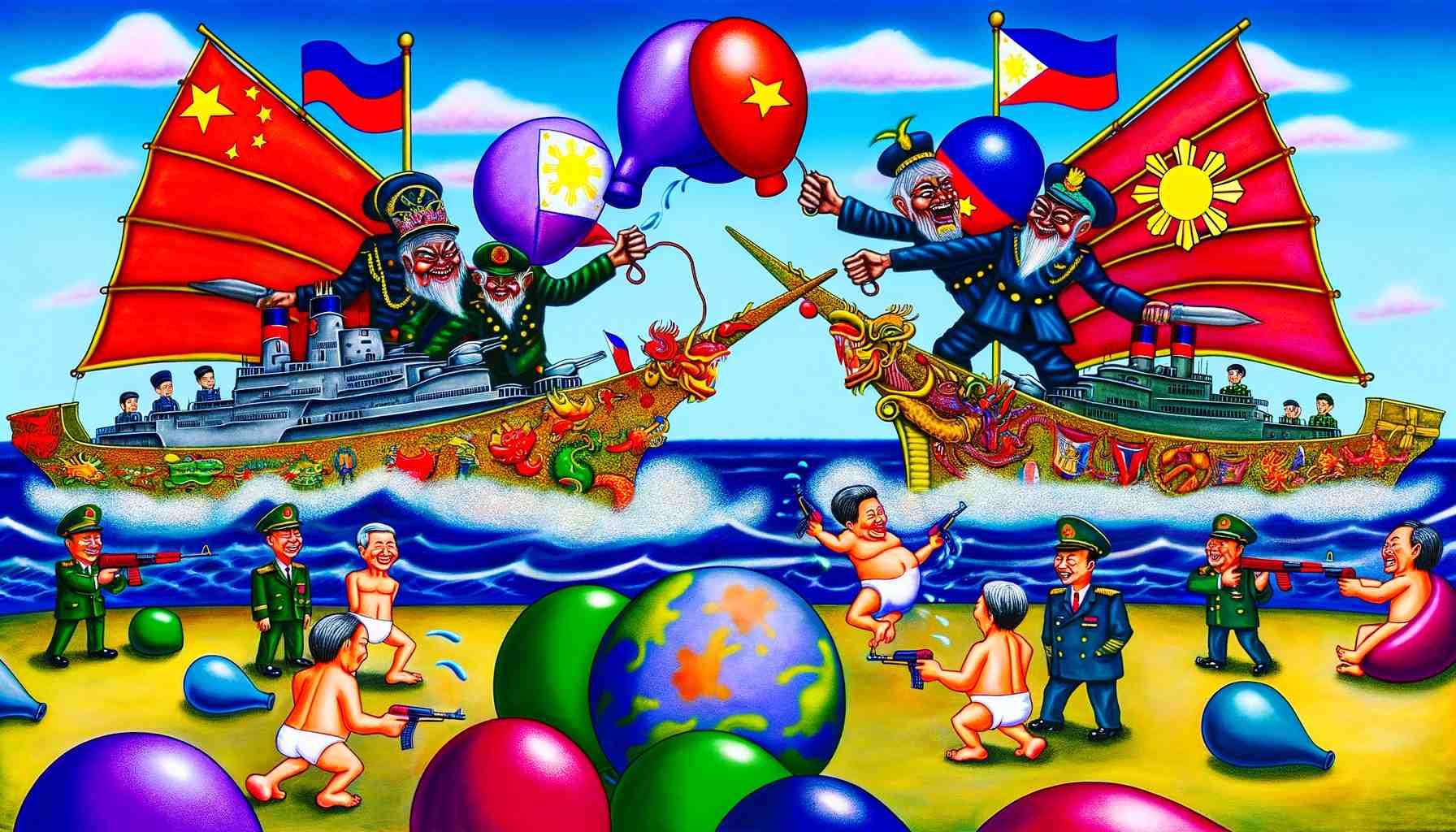
Another, facing questions about the freedom of navigation operations, said with a smirk, “Our ships go where international law allows, except when they accidentally enter territorial waters – that’s when they’re just ‘on vacation.'” A diplomatic way of saying ‘Oops, my GPS must be sunbathing too.’
When challenged on the overlapping claims, a representative from one claimant state offered, “We’re all just fans of Venn diagrams, especially the part where all the circles overlap. That’s the sweet spot!” Mathematics, it seems, has never been invoked with such geopolitical guile.
Confronted with the complexities of historical claims, one statesman offered a historical tidbit with a twinkle: “According to ancient manuscripts, our ancestors frequented these waters. They were excellent swimmers, you see.” A statement that invokes more the spirit of Olympic contention than legal precision.
On the topic of natural resource exploitation, a government spokesperson wryly noted, “It’s like we’ve all got straws in the same drink. The trick is figuring out who gets to slurp first.” Resource sharing as envisaged by a kindergarten squabble over a juice box.
During a discussion on military exercises in the region, a military attaché joked, “We’re just out here playing Marco Polo. Except, instead of closing our eyes, we’re closely monitoring each other with high-resolution satellite imagery.” This hide-and-seek game evidently involves some very expensive toys.
Amidst escalating tensions, a foreign minister deadpanned, “We’re all committed to maintaining peace and stability in the region—think of it as an arms-laden potluck where everyone brings their biggest dishes.” Certainly, an unusual way to describe the gathering of warships, and not nearly as congenial as a Sunday church picnic.
In a particularly candid moment, one official mused, “Claiming islands is like collecting stamps – except you can’t just trade them with your friends when you get bored.” Clearly, geopolitical strategy has much in common with childhood hobbies.
Discussing the ecological impact of island-building, a spokesperson offered, “We’re just trying to create more habitats for fish – even if they’re made of concrete.” One cannot help but admire the marine creatures’ adaptability to their new, rather unorthodox abodes.
An envoy, emphasizing their country’s restrained approach, said, “We’re committed to a diplomatic solution. We’ve even considered writing our grievances in a message bottle, but we can’t agree on the font.” In the digital age, it seems typographical disputes could be the new frontier of international relations.
Referring to the occasional stand-offs between vessels, another official commented, “It’s like an elaborate game of Battleship, but everyone’s ships are unsinkable and crewed by lawyers.” The legal battles waged on these waters could sink a fleet of galleons with sheer paperwork.
Reacting to accusations of encroaching upon neighbors’ territorial waters, one representative retorted, “We just thought it was bring-your-boat-to-work day.” A jovial take on a complex issue, though unlikely to smooth ruffled diplomatic feathers.
And lastly, in a moment of levity, a military official described their surveillance activities: “We see no ships—only friendships.” A nautical adaptation of the classic ‘I see no evil’ that would have admirals of yore turning in their briny graves.
As our officials jostle, jape, and juggle words, the waters may not get any clearer, but our spirits remain buoyed by their wit—or at least by their ability to produce a guffaw. The West Philippine Sea, as painted by these characters, resembles less a battleground of national interests and more an aquatic carnival where everyone is invited, but the rides are admittedly a bit intense.
Sharing firsthand funnies from those who navigate these waters, from fishermen with more tales than catches to tourists who thought they were on a cruise, adds another layer to the cartographic caricature we sketch. As we pull up our anchors of amusement, let’s cast a wide net to catch more amusing anecdotes from the bountiful brine of the South China Sea comedy club.
Personal Anecdotes Ahoy!
Navigating through the choppy discourse surrounding the West Philippine Sea, one stumbles upon treasure troves of personal anecdotes that bob up from the depths like buoyant bits of comedy. The individuals directly embroiled in the maritime melee have their own tales to tell, with splashes of humor often serving as their life jacket in an ocean of uncertainty.
Take for instance Mang Tonyo, a fisherman whose family has cast nets in these waters since his great-grandfather’s days. Mang Tonyo chuckles as he recounts the territorial face-offs he’s witnessed. “Sometimes, you see more ships than fish,” he says, tugging at his wide-brimmed hat. “I drop my line hoping for a big catch, and pull up a submarine periscope. They wave at me, I wave back, we share a moment, then it’s back to business.” The fisherman’s sun-leathered face crinkles into a smile, hinting that undercurrents of camaraderie can exist even amongst rival navies.

Then there’s Sarah, a millennial travel vlogger whose sailing trip “to find the most instagrammable sunset” inadvertently turned into a geopolitical documentary. “So there I was, selfie stick in hand, ready for that golden hour glow, when this massive naval vessel photobombs me,” she giggles, her latest video capturing her bewildered expression as a backdrop to the gray hulk of a destroyer. “Turns out, they thought my catamaran was some new stealth vessel. Stealthy? Yes, until I start singing my karaoke.” Her video, captioned “When your backdrop drops bombs,” went viral, transforming a tense situation into a social media sensation.
In the case of Greg, a scuba instructor, his underwater haven became a stage for sovereignty skirmishes. During a dive, Greg and his group found themselves floating above a submerged ‘No Trespassing’ sign, inexplicably planted on a coral outcrop. “We took selfies with it,” Greg admits with a snicker. “Not every day you need a passport to visit a fish.” His anecdote showcases the submerged absurdity of the disputes, with aquatic residents blissfully unaware of the human squabbles overhead.
Local businesses have their share of maritime mirth too. Jenna, who runs a seaside café, recalls a day when her establishment was suddenly full of serious-faced men in suits, whispering into earpieces. “They told me they were monitoring some ‘sensitive activities,'” she recounts with amusement. “Meanwhile, I’m trying to explain that my ‘floating device’ out back is just an inflatable doughnut, not a covert signaling buoy.” Her café now advertises “Espionage Espresso – so good it’s classified,” a nod to the day her cappuccino foam ‘stirred’ international interest.
Not to be outdone, regional officials sometimes partake in the unintended jest. Mayor Delgado, known for his gregarious personality, once hosted a press conference on a small, disputed islet, declaring it a new ecotourism hub. “Here, the only battles are between the sea turtles for the best sunbathing spots,” he proclaimed, while behind him, a confused sea turtle head-butted his tripod, toppling it over mid-speech. The resulting footage made for a poignant, if slightly slapstick, statement on the true occupants of the disputed zone.
A group of enterprising local teens decided to cash in on the curiosity surrounding the sea’s name itself. They set up a stand selling “Authentic West Philippine Sea Water” – bottled straight from the source, with each vial promising a splash of sovereignty. Their cheeky enterprise caught the attention of passersby, if not for its political satire, then for its entrepreneurial spirit. “Get your piece of the sea, no naval escort needed,” they chant, as customers line up for a memento of maritime madness.
Bringing a dash of levity to an otherwise strained situation are tour guides like Michael, who spins yarns to entertain his clients as they sail past navy vessels. “And to your left, you’ll see a fine example of contemporary sea fortress architecture,” he jests, gesturing towards a foreign warship, “Notice the sleek lines, the minimalist color palette, and the avant-garde use of radar dishes as decorative elements.” His tours, known for blending humor with history, have become quite the attraction, selling out despite the occasional diplomatic discomfort.
These snippets of life in the West Philippine Sea paint a picture of a region where, despite the simmering tensions and high-stakes gamesmanship, there’s room for a shared chuckle. The tales are often told with a wink and a nod, hinting at an underlying resilience and a shared humanity that persist even as the waves of geopolitical posturing rise and fall.
Polling the Peculiar Perspectives
Ahoy there! In the capricious currents of public opinion, we’ve cast our net far and wide to capture the colorful convictions of the good folk regarding the briny brouhaha that is the West Philippine Sea. Buckle up, shipmates, for we’re about to embark on a whimsical voyage through a sea of surveys that reveal the humorous and sometimes head-scratching views held by the populace.
Surveying the Sea of Sentiments

A recent poll, a beacon of hilarity in the murky waters of maritime dispute, shows that 75% of respondents believe that the best strategy for defending our sovereign sea-sprawl is by unleashing our secret weapon: an army of fiercely patriotic sea turtles. Armed with nothing but their hard shells and a no-nonsense attitude towards territorial lines, these slow-moving sentinels of the sea garnered surprising support from citizens. They seemingly preferred the company of these shelled warriors to that of human patrols, which according to a whispered addendum to the survey, lack the turtles’ natural charisma and unflappable poise.
Another survey, glittering with the comical gems only a politically charged populace could provide, suggested that 60% of locals favored the idea of renaming the West Philippine Sea to something more fitting of its dramatic role on the world stage. Top contenders included “The Aquatic Theatre of Dreams,” “The Sea of Suspense,” or “The Oceanic Octagon,” with respondents commenting that such names would, at the very least, ensure that any territorial tiff had a suitably grandiose title.
Charting the Comedic Coordinates
But wait, there’s more – for when the question of resource allocation was raised, 52% of those surveyed claimed that they would rather see funds invested in creating a reality TV show called “Survivor: Sovereignty Edition” than in diplomatic endeavors. Contestants would be plucked from the ranks of our noble leaders and set adrift on a raft in the contested waters, armed with nothing but wits and fishing rods, to settle disputes through a series of challenges. Ratings, as one enthusiastic respondent predicted, would be off the charts, and the issue resolved with as much dignity as a reality show can muster.
In the depths of another poll’s data, a staggering 63% argued that the ultimate solution to the territorial spat would be to simply host an underwater summit, where leaders would have to don scuba gear and negotiate around a table of coral. This, they claimed, would provide an immersive (quite literally) experience that would foster understanding. “Fish don’t recognize borders,” one respondent bubbled, perhaps unaware of the pun they were crafting, “so why should we?”
Netting the Nautical Nonsensicalities
And who could forget the 48% that humorously proposed establishing an “International Sea-zure Hotline,” where concerned citizens could report any sightings of suspicious sea creatures that might, in fact, be undercover agents of a rival nation. “Saw a crab reading a map? Call the hotline!” touted the suggestion. One must ponder if these callers expected the crustaceans to be wielding tiny compasses and spyglasses or perhaps engaging in clandestine discussions with unassuming octopi.
Furthermore, a head-tilting 55% declared they would willingly accept the role of human buoys if it meant peacefully resolving the dispute, suggesting they’d bob in the waters, sun hat on head and sunglasses perched, to mark the boundaries personally. One has to admire the commitment to conflict resolution, though concerns regarding sunburn and hydration were notably absent from this amusingly earnest proposal.
The Crow’s-Nest View of Consensus
Rising above the comical fray, a whopping 80% of those polled agreed on one critical point: the West Philippine Sea kerfuffle would make an exceptional backdrop for a blockbuster action movie. With visions of high-speed boat chases and dramatic flag-planting scenes, citizens across the board were excited by the prospect of seeing their maritime melodrama play out on the silver screen. “Just imagine,” one respondent mused with a twinkle in their eye, “Our very own saga of the sea, complete with slow-motion walks away from explosions on water skiffs!”
In an illuminating display of unity, when asked about the effectiveness of governmental response to the territorial disputes, responders revealed a trend as predictable as the tides. A sizeable portion snarkily suggested that officials were using “Where’s Waldo” books as strategic guides for locating islands, with a slim majority convinced that this method was just as effective as current strategies.
And as we sail toward the horizon line of public polling, it appears that the West Philippine Sea saga has become a buoyant battleground where the currents of creativity and the gales of guffaws intermingle. So, as we chart these wondrous waters of whimsy, let us not forget that beneath the froth of frivolity, there lies a depth of dialogue and an undercurrent of earnest hope for a peaceful resolution to these age-old disputes. But until that day, we’ll keep our life vests of levity securely fastened.
Cause, Effect, and the Ripple of Laughs
In the brackish brew of international waters, the chain reactions in the West Philippine Sea unfold like a comedy of maritime errors, each act prompting guffaws and gasps from our audience on shore. The cause-and-effect relationships here are as knotted as a fisherman’s net after a particularly fractious catch, but fear not! For wit and satire shall serve as our navigation tools through this geopolitical quagmire.
The Farcical First Act: A Sovereign Sea or a Sea of Sovereignty?
Our saga begins, as many do, with an assertion of “This is ours!” voiced with the same conviction as a toddler claiming dominion over a sandbox. Take, for example, a nation that unfurls a map older than my great-aunt’s lace doilies, pointing to a dashed line as wavy as the sea itself and declaring, “Behold our ancestral swimming pool!” And thus, a spritz of international sprightliness is added to the mix.
Then, in what can only be described as a heroic effort to make cartographers the world over toss their compasses in despair, this claim is contested by a chorus of others, each crooning their own historical tune. It’s like a karaoke showdown where the prize is territorial tenure and the high notes are hit with diplomatic diatribes rather than vocal veracity.
The Splashy Sequel: The Flotillas Flounce In
As sure as the tide, this cartographical cacophony causes ripples. Soon, waters are dotted with more vessels than a bathtub toy collection. From fishing boats armed with nothing but nets and moxie to naval behemoths bristling with an armory enough to make Neptune himself consider early retirement. Each flotilla flounces with the braggadocio of a peacock in full plume.
Some might fish, others may patrol, but all seem to be performing an intricate nautical ballet choreographed by a general who confused “naval strategy” with “synchronized swimming.” The effect? A maritime muddle where a fish might mistake a submarine for a playmate, and a sea turtle is half-convinced it’s stumbled onto the set of a reality TV show.
The Comedic Climax: The Islet Incident
Cue the comedic climax, where a tiny islet, minding its own business and probably contemplating the complexities of coral reef society, becomes the unwitting belle of the geopolitical ball. With all the pomp of a suitor’s serenade, various nations swoop in with the fervor of adolescents at prom, each trying to pin a corsage on the rock and proclaim it their dance partner for the ages.
This leads to a series of effects that would make Rube Goldberg raise his eyebrows in approval. A flag is planted, a rival flag is unfurled, and before you know it, we’ve got enough flags for an impromptu United Nations conference in miniature. Islets are, after all, not known for their capacious conference halls.
The Punchline Postlude: A Coalition of Cartoons
In the wake of these territorial tangoes, alliances are formed not unlike those childhood pacts made in treehouses, but with more suits and less lemonade. Coalitions spring up as if they were mushrooms after a rainstorm, each proclaiming mutual support with the solidity of a handshake through a hologram. They trade barbs, issue statements, and sometimes, when they’re feeling particularly churlish, send sternly-worded letters that get all the attention of a spam email.
One nation dispatches ships to loiter with the casualness of teenagers outside a convenience store, their presence as welcome as a seagull at a beach picnic. Another organizes military exercises that seem more like extravagant aquatic flash mobs, dazzling in their complexity and likely as bewildering to the local marine life as a firework display to a herd of cows.
Yet, through these frothy frolics of statecraft, we must recognize the deeper undercurrents. Actions taken have repercussions that ripple far wider than the wake of a battleship. They affect livelihoods, ecosystems, and the precarious peace that hangs like a hammock in a hurricane. And though we chuckle at the bumbling bureaucracy and diplomatic dabbling, the sobering reality is that beneath the veneer of satire lies a complex chess game played on a board of blue.
So, as we watch this marine melodrama unfold, let us be mindful that for every jest there’s a story, for every parody, a point. As we navigate through the whimsical waves of the West Philippine Sea, we do so with a smirk at the silliness, but also a solemn nod to the profound. And remember, amid the geopolitical gags and aquatic absurdities, even the most seemingly insignificant pebble can create waves that traverse oceans.
Deducing with Deductions
With the precision of a laser-guided seagull targeting your ice cream cone, let us apply our best Sherlockian scrutiny to the grand enigma that is the West Philippine Sea dispute. Picture, if you will, our geopolitical Great Detective donning his deerstalker cap, trading foggy London for the briny breeze, and addressing this territorial tangle with the sort of deductive reasoning that would make a game of Clue look like mere child’s play.
Elementary, My Dear Fishermen
The game is afloat, and our first clue arrives on the gentle waves like a message in a bottle. Countries fling claims over the waters with the casual abandon of a beachgoer tossing frisbees. To deduce the rightful claims, one might assume it’s as simple as tracing lineage – a sort of ancestral aquatic Ancestry.com. But alas, this sea saga has more plot twists than a telenovela.
Our first deduction must be that historical claims are a slippery slope, greased with the eel-like slickness of political rhetoric. If Nation A asserts that their great-great-great-grand-Admiral once took a leisurely swim across these waters, is that a valid claim? And if Nation B counters with tales of ancient trade routes, are we not compelled to acknowledge their seafaring savoir-faire?
Our detective might note, with an arched eyebrow, that the bold assertions are as robust as a sandcastle at high tide. The court of public opinion is no Supreme Court, and memories are as mutable as the shoreline, reshaped with every storm of controversy.
The Adventure of the Dancing Delimitations
Now, let us turn our gaze to the foxtrot of maritime boundaries. This is where cartographers become inadvertent comedians, redrawing lines like amateur etch-a-sketch artists. The baseline is drawn, boundaries are claimed, but is the result as clear as the crystal waters they delineate? Hardly.
Our detective, through a cloud of pipe smoke (environmentally friendly, of course), observes that these lines are like the invisible beams in a high-stakes laser heist movie. Each country tip-toes and contorts through them, occasionally setting off alarms and causing a diplomatic ruckus.
One deduction stands out: in this dance, the music never stops, and partners are swapped with the grace of a diplomatic do-si-do. Countries assert their Exclusive Economic Zones (EEZ), but the exclusivity is as questionable as a pirated DVD. Is it an EEZ, or is it, as our detective quips, “rather breezy with all this bluster”?
The Hound of the Hydrocarbons
Our intrepid detective’s next stop is the murky depths, where lies the bounty of natural resources – the bones over which these hounds of statehood howl. The scent of oil and natural gas draws them, and it’s no game of fetch but a serious pursuit of energy security and economic clout.
Yet, our detective deduces that these resources are not so easily sniffed out. Geopolitical geologists, armed with seismic sensors, are the new-age bloodhounds. But who gets to lead the pack? The country with the most sophisticated snout, or the one that barks the loudest?
Our detective knows that when it comes to hydrocarbons, every country wants to be the top dog. But in this game, the fire hydrant of sovereignty is often out of reach, hidden behind a thicket of legal wrangling and environmental concerns.
The Case of the Camouflaged Craft
Our narrative takes a shadowy turn as we examine the flotillas of fishing boats, coastguard cutters, and steel-hulled naval vessels that dot the seascape. They’re like chameleons on the ocean blue, each claiming innocuous intent while camouflaged with clandestine capability.
Through his magnifying glass, our detective sees beyond the masquerade. The fishing trawlers are not just in pursuit of the daily catch but are baited hooks in the geopolitical game. The naval vessels are not merely joyriding in international waters; they’re chess pieces on a fluid board, knights and rooks in maritime armor.
One must deduce, then, that the innocent fisherman’s tale of a simple life at sea is as quaint as a faded postcard of a beach resort. In these contested waters, every vessel is both observer and observed, participant and provocateur.
The Final Problem of the Floating Flags
Lastly, our detective ponders the symbolism of flags staking claims on bits of rock and reef. In an act of ceremonial sovereignty, nations plant their banners as if claiming the moon. Yet, our detective’s shrewd deduction here is that flags flap, but do they root?
He surmises that while fabric may flutter in the wind, it is the actions on the ground – or, indeed, in the water – that anchor a nation’s presence. The true test of sovereignty, our detective concludes, lies not in the colored cloth that adorns an islet, but in the enduring commitment to uphold international law, nurture the marine environment, and ensure the peaceful resolution of disputes.
So, there we have it. The clues scrutinized, the deductions made, all with the irreverence of a sea lion clapping at the circus. As the sun sets on our day of satirical sleuthing, we are left to muse upon the wavy line between jest and justice.
And now, for a statistical sea shanty to serenade you with figures and facts, for what is a detective’s work without the data to back it up? Let us tally the tales of territorial tumult and take stock of the numbers nestled within the nautical nonsense.
Statistical Shenanigans
Statistical Shenanigans
And now, let us meander through the mosaic of mind-bending metrics with the serenity of a sea turtle wading through a sea of spreadsheets. Here, where the rubber duckies of reason bob in the bathtub of bewildering data, we invoke the power of numbers to illuminate, elucidate, and most certainly, to amuse.
Take, for instance, the arresting arithmetic of naval natter: the innumerable vessels that paint these hotly contested waters with the artistry of a toddler’s finger-painting project. The South China Sea is as crowded as a Black Friday sale at an electronics store, with reports suggesting that, at any given moment, you could be sharing the waves with no less than a thousand boats, ships, kayaks, and the occasional daredevil on a pool floatie. The question remains: how many are fishing boats, and how many are just discreetly pretending to enjoy a good trawl while eavesdropping on maritime musings?
Speaking of eavesdropping, a certain large country – which shall remain unnamed but is famously fond of pandas and the Great Wall – is rumored to have their warships linger with the stealth of a cat at a mouse convention. An anonymous eyewitness account, likely from someone who’s watched one too many spy thrillers, quipped, “Those ships were so quiet, you could hear a sea urchin burp from the deck.” This statement, while biologically dubious, underscores the silent tension that pervades these placid waters.
Let’s paddle on to the fishy tale of fisheries. The West Philippine Sea is said to provide sustenance for millions, a veritable aquatic breadbasket. Yet, certain piscatorial populations have seen declines sharper than the wit of a stand-up comedian at an open mic night. The culprits? Overfishing and territorial tensions, spooking the fish like a horror movie marathon at the aquarium. The real horror, however, is in the numbers: an estimated 25% drop in some fish stocks, which, if not curbed, might lead future generations to believe that ‘seafood’ was just a mythological concept like mermaids or honest politicians.
Now, dear reader, let’s delve into the mathematical maelstrom of the Exclusive Economic Zones (EEZ). The EEZs are the sea’s equivalent of a backyard – each country gets 200 nautical miles from their coast to call their own, for fishing, drilling, or holding underwater tea parties. Yet, one can’t help but be amused by the arithmetic anomalies that arise when overlapping claims are more common than barnacles on a hull. If every nation stuck to their prescribed EEZ, we’d need a sea larger than Jupiter’s ambitions to accommodate them all.
Furthermore, let’s not forget the delicious demographics of the local populations, where the number of people who can recite their country’s territorial claim verbatim might just outnumber those who can remember where they put their keys. Opinion polls show that an overwhelming majority in each claimant country is convinced of their rightful ownership, presenting statisticians with figures that might confuse even Pythagoras himself.
And how can we forgo the economic estimates? A barrel of laughs, really, if barrels were filled with potential oil and gas reserves that countries eye with more desire than a seagull eyes your beach picnic. The West Philippine Sea is believed to sit atop vast underwater reserves, enough to make any nation’s treasury blush with excitement. The specific figures, however, are as elusive as a philosophical octopus pondering the meaning of ink. Experts toss around numbers reaching into the billions of barrels of oil and trillions of cubic feet of natural gas, though one can imagine that the actual process of counting each molecule must be dreadfully time-consuming.
In the spirit of keeping our statistics as grounded as an anchor in a sandbank, let’s consider the legal legwork. The number of filed grievances, protests, and strongly worded letters could probably paper over the disputed islands, effectively creating the world’s most litigious mosaic. All this paperwork has culminated in various international court decisions, though the effectiveness of these judgements in resolving disputes is about as clear as mud after a submarine demolition derby.
Not to be overlooked is the tourism turnover, because nothing says ‘holiday destination’ like disputed waters and diplomatic standoffs. Tourist arrivals to the nearby beach resorts are a rollercoaster ride worthy of an amusement park, their numbers undulating like the waves they overlook. The intrepid adventurers who do venture forth to these locales seem undeterred by geopolitics, which is fortunate because the most recent addition to the local marine life is submarines masquerading as giant metal fish.
As we surf the wave of statistical wonder, consider the knots of naval power: a metric that baffles even the bravest seafarers. The regional waters have seen naval buildups that could make a Viking feel insecure about his longboat. As for the number of military drills and joint exercises conducted in these waters? Well, let’s just say that the South China Sea might as well have its own season pass to the gym, given how ‘swole’ it’s becoming with maritime muscle flexing.
Finally, we must tip our captain’s hat to the environmental impact assessments. They read like a love letter to future generations, begging forgiveness for the coral reefs that now resemble a ghost town and the migratory routes that have become obstacle courses. The irony is not lost on us: in the pursuit of claiming the sea, there might be considerably less of it worth claiming.
So there you have it, dear readers, a sea shanty sung in the key of numbers – a statistical serenade to the intricate, intriguing, and oft-irrational narrative that is the West Philippine Sea. May your compass always point towards laughter, and your charts be free of the perilous shallows of seriousness.
Originally posted 2024-03-18 20:12:46.