

EDSA Goes Car-Free for 24 Hours—Filipinos Celebrate by Walking in Perfect Circles Like Lost Ants
By Bohiney.com Staff Report | September 21, 2025
Manila’s Traffic Nightmare Becomes Pedestrian Comedy Show
In a bold experiment that would make even Jerry Seinfeld question Filipino logic, EDSA went completely car-free for 24 hours this weekend, following similar experiments in London’s Oxford Street. What was supposed to be a demonstration of sustainable urban planning quickly turned into the world’s most expensive lesson in human navigation failure.
EDSA, Manila’s busiest highway that normally handles over 400,000 vehicles daily despite having capacity for only 300,000, suddenly became a stage for what urban sociologists are calling “the Great Filipino Circle Walk of 2025.”
Pedestrians, freed from the life-or-death obstacle course of jeepneys, buses, and motorcycles, responded by creating their own chaos: walking in perfect geometric patterns like they’re auditioning for a really confused flash mob.
“I thought I’d feel liberated,” said Maria Santos, clutching her Jollibee cup while completing her tenth lap around the same MRT station pillar. “Instead, I feel like I’m trapped in a human screensaver. Parang robot ako!”
The Great Migration to Nowhere Along Asia’s Longest Avenue
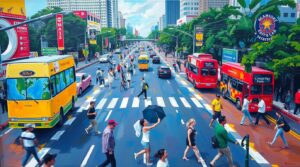
Within minutes of EDSA’s closure to its usual 23.8-kilometer stretch of vehicular chaos, the Philippines’ premier traffic nightmare transformed into what behavioral experts are calling “a live-action meditation performed by confused commuters.”
Witnesses reported spontaneous circular formations appearing around SM Megamall, Robinson’s Galleria, and the iconic MRT stations from North Avenue to Taft. One particularly dedicated individual was observed orbiting a Ministop for 42 minutes straight, apparently achieving enlightenment through repetitive motion and mild caffeine withdrawal.
“It’s like watching a nature documentary about Filipino herd behavior,” said Dr. Jose Rizal Cruz from University of the Philippines, who spent the day documenting OFWs walking into the same 7-Eleven with impressive consistency. “Remove the predators—in this case, jeepneys and buses—and Filipinos immediately forget how to navigate. Sobrang weird!”
Jerry Seinfeld perfectly captured the absurdity: “What’s the deal with giving Filipinos an entire highway and they use it to walk in circles? That’s not freedom, that’s just OCD with better street food.”
Freedom Feels Like a Glitch in the Filipino Matrix
Turns out that when you remove the constant threat of being sideswiped by a tricycle or flattened by a provincial bus, Metro Manila residents experience what psychologists call “navigational paralysis with a side of existential pagkapagod.”
“Dati, I just follow the jeepney route and hope for the best,” confessed Juan dela Cruz, a call center agent who’d been circling Ortigas Center like a lost satellite. “Without vehicles to guide me, I’m basically expensive human driftwood. Walang direction talaga!”
Parents attempted damage control by handing out MRT maps to their children, who promptly repurposed them as construction material for elaborate Red Ribbon box fortresses. Meanwhile, Manila’s street cat population staged what can only be described as a hostile takeover, claiming sections of EDSA as their rightful territory and leaving fishball grease patterns in what appeared to be Feline Profanity.
Ron White nailed it: “You can’t fix stupid, but you can give it a 23-kilometer highway to demonstrate just how stupid it really is. These people make my drunk stories look like GPS instructions.”
The Wellness Mafia Strikes Back in Makati
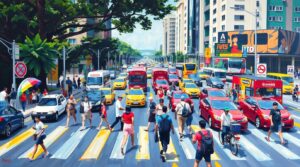
Because nothing says “reclaiming public space” like privileged Makati residents doing yoga poses in the middle of the Philippines’ economic artery, approximately 60 wellness enthusiasts descended upon EDSA with the coordination of a flash mob and the self-awareness of a GMA soap opera character.
The self-proclaimed “Namaste EDSA Collective”—a name that sounds like a pharmaceutical side effect mixed with Filipino colonial mentality—claimed sections of roadway for what they called “urban mindfulness practice.” In normal Tagalog, this translates to “mag-stretching habang confused shoppers navigate around you like you’re a very zen traffic cone.”
Steve from Antipolo attempted to organize a community boodle fight, laying out rice, adobo, and San Miguel Beer with the optimism of someone who’s clearly never experienced Metro Manila’s social dynamics. Instead of joining him, pedestrians treated his banig like a roundabout, circling his spread while filming TikTok videos and maintaining the social distance typically reserved for tambay with questionable hygiene.
“I wanted to bring the bayanihan spirit back,” Steve said, watching his 67th human orbit while balut vendors circled him like vultures. “Instead, I’ve become a gravitational anomaly for lost commuters. Someone tagged me as ‘Sad Tito Steve’ on Facebook.”
Amy Schumer summed it up perfectly: “It’s like musical chairs, but the chairs are invisible, everyone’s confused, and the music is just the sound of GCash notifications not being used.”
Mall Owners Learn That Circular Motion ≠ Circular Spending
EDSA’s retail empire, which typically extracts money from Filipinos with the efficiency of a PCSO lotto machine, faced an unexpected challenge: customers who move constantly but buy absolutely walang-wala.
“They’re here, pero they’re not shopping,” said Patricia Hernandez, manager at SM North EDSA, watching customers orbit her mall like confused OFW satellites. “They examine our window displays, circle them exactly three times, then continue their migration. We’ve started calling them ‘tignan lang’ birds instead of customers.”
A leaked internal memo from a Bench store near Quezon Avenue instructed staff to “encourage customers to pause their circular walking pattern to appreciate our sale items, then resume their orbit. Remember: time is money, pero apparently walking in circles is libreng entertainment.”
Sales data revealed a 400% increase in foot traffic and a 60% decrease in actual purchases, leading one retail analyst to conclude: “Removing cars doesn’t make Filipinos buy more stuff. It just makes them walk around the stuff they can’t afford with mathematical precision. Classic Pinoy window shopping elevated to performance art!”
Jeepney Drivers Watch Their Territory Get Colonized
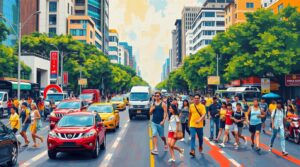
The city’s jeepney drivers and bus operators, temporarily displaced from their natural hunting grounds along EDSA’s 23-kilometer stretch, observed the pedestrian chaos with the mixture of fascination and horror typically reserved for ABS-CBN teleseryes about separated families.
“Dalawang dekada ako nagdodrive dito sa EDSA,” said one anonymous jeepney driver, nursing a Red Horse beer while watching from a nearby carinderia. “Now it looks like someone released a bunch of human hamsters into the world’s most expensive maze. These people couldn’t navigate their way out of a Robinson’s paper bag with GPS and a tour guide.”
Habal-habal drivers attempted to maintain normal operations but found themselves trapped in spontaneous human roundabouts. Several reported being “caught in the pedestrian current” for extended periods, unable to break free from the circular flow of confused millennials and Gen Z Filipinos.
“I tried to deliver Grabfood to Greenhills,” said one motorcycle taxi rider. “Instead, I got caught in a human conga line that was following another human conga line. Parang Amazing Race pero walang prize, walang direction, at walang sense!”
Environmental Victory Through Filipino Confusion
Manila’s environmental officials declared the day an unqualified success, primarily because air pollution plummeted while human entertainment value skyrocketed to levels not seen since Wowowee was still on the air.
“Carbon emissions dropped to near-zero levels, nitrogen dioxide vanished, and the only pollution came from confused sighing and the occasional frustrated ‘Ay, nako!'” reported Clara Olivares, Environmental Strategist for Metropolitan Manila Development Authority. “Sure, people are walking in patterns that would make rice terraces jealous, pero at least they’re breathing clean air while doing it.”
The MMDA office released a statement: “Today proves that sustainable transport initiatives work, even if sustainable Filipino behavior remains a theoretical concept like traffic discipline and following lane markings.”
Air quality monitoring stations recorded the cleanest readings since Mount Pinatubo erupted, though noise pollution remained constant due to the persistent sound of people asking “Saan yung MRT?” while standing directly underneath the station’s illuminated sign.
The Science of Filipino Urban Stupidity
Dr. Maria Felicidad Santos, a behavioral psychologist from Ateneo de Manila University, spent the day documenting what she termed “the fastest real-time demonstration of Filipino navigational dependency in recorded history.”
“Remove external guidance systems, and Filipinos immediately default to the most basic geometric pattern available: the circle,” Santos explained while watching a BPO worker complete his 31st orbit of a Jollibee. “It’s like watching someone’s internal GPS crash and reboot in safe mode. Their navigation system has blue-screened, so they’re running on backup programming from the Stone Age.”
Her preliminary research suggests that modern Metro Manila dwellers have become so dependent on jeepney routes and bus stops for directional guidance that removing vehicles is equivalent to “deleting the GPS from Filipino collective consciousness and replacing it with a broken compass that only points to ‘confused’ and occasionally ‘gutom.'”
Sarah Silverman observed: “Filipinos would rather walk in circles than admit they don’t know where they’re going. It’s like GPS for people who are too proud to ask for directions, but with more street food vendors watching them fail.”
Safety Measures: Protecting Filipinos From Themselves
Metro Manila authorities deployed tactical concrete barriers and emergency seating to prevent pedestrians from wandering into actual danger zones. However, these safety installations became inadvertent rally points for the geometrically challenged masses.
Barriers transformed into waypoints for elaborate circular routes, while waiting sheds served as rest stops where people could plan their next geometric adventure while sharing chismis about their circular walking experiences. Philippine Red Cross teams reported a 300% increase in “pedestrian vs. stationary object” incidents and several documented cases of “chronic circular walking syndrome.”
“I did figure-eights for four hours straight,” said Emily Cruz, 28, collapsed on a bench near SM Mall of Asia, fanning herself with a Bench flyer. “I felt productive, pero I couldn’t explain why. Then I realized I was just walking in expensive shapes. Very expensive shapes, considering this is Metro Manila real estate.”
First aid teams established “Directional Recovery Stations” where disoriented pedestrians could receive complimentary laminated maps and basic navigational counseling in Tagalog, English, and broken Taglish. The most common treatment involved pointing confused individuals toward the nearest MRT entrance and providing gentle encouragement to walk in straight lines while avoiding street vendors.
The Economics of Geometric Filipino Confusion
EDSA businesses attempted to monetize the circular walking phenomenon with mixed success. Uniqlo promoted “Circle-Walking Comfort Collections,” while H&M advertised “Geometric Navigation Gear for the Modern Filipino Wanderer.”
Souvenir shops near MRT stations reported strong sales of commemorative T-shirts reading “I Survived the Great EDSA Circle Walk of 2025” and “My Parents Went Car-Free and All I Got Was This Confusing Geometric Migration Pattern (Plus Unlimited Rice).”
The Philippine Retailers Association issued an official statement: “While foot traffic increased exponentially, conversion rates plummeted dramatically. Apparently, walking in circles burns calories but not peso bills. Typical Filipino behavior: magpapagod pero walang gastos!”
One enterprising street vendor began selling “Professional Circle Walking Maps” for ₱250 each—essentially blank pieces of paper with a single circle drawn in marker and a small Philippine flag sticker. He sold 487 copies before anyone questioned the business model, proving that Filipinos will buy anything if it comes with a flag.
Future Planning: The Circular Economy (Literally Filipino Style)
Urban planners are already developing permanent car-free street initiatives based on the day’s “overwhelming success na may halong confusion.” Proposed implementations include:
- Weekly “Circular Walking Championships” along Commonwealth Avenue
- Professional circular walking lanes with directional guidance arrows and Baybayin signage
- Certified circle-walking instructors stationed at major confusion points, preferably with tourism training
- Emergency “straight line” escape routes for people experiencing geometric vertigo and hilo
One MMDA official, speaking anonymously while enjoying halo-halo, warned: “Give Filipinos space without vehicles, and they’ll immediately turn it into an inadvertent geometry lesson with food vendors. Give them geometry lessons, and they’ll somehow find new ways to get lost in shapes they’re creating themselves while looking for the nearest jollibee.”
As documented in our original London investigation, the Department of Transportation announced plans to implement monthly car-free days, noting: “If Filipinos prefer walking in circles, we’ll provide them with the most expensive, well-maintained circles in Southeast Asia, complete with air conditioning and Wi-Fi.”
Professional Comedy Commentary (International Edition)
Jerry Seinfeld provided the day’s most insightful analysis: “You remove cars from a Filipino highway, and people immediately start walking like they’re trapped in a human washing machine with really good street food. What’s next—removing jeepneys and watching everyone hop on one foot while singing Anak?”
Ron White added his perspective: “I’ve witnessed drunk Americans navigate mall parking lots with better spatial awareness than these completely sober Filipinos on their busiest highway. At least drunk people have chemical excuses for circular walking—these folks are just naturally directionally challenged, pero with better food options.”
Amy Schumer concluded: “This is the most cardiovascular exercise these people have experienced since the last MMFF mall stampede, and they’re executing it incorrectly. They’re essentially jogging in place while technically moving. It’s like cardio designed for people who hate making actual progress but love rice.”
Filipino Comedian Reactions (Local Edition)
Vice Ganda observed: “Mga ate, walking in circles lang naman pala ang traffic solution! Pwede ring exercise, pwede ring entertainment. Pero sana may audience at may prize money!”
Michael V noted: “Nakakahilo naman yung mga tao! Parang washing machine na may paa. Sana may fabric conditioner para smooth ang takbo!”
Alex Gonzaga commented: “Circle challenge pero walang TikTok trend! Sayang, pwede sanang viral ang EDSA Circle Walk Challenge with matching dance steps!”
The Aftermath: Lessons in Filipino Behavior
After 24 hours, EDSA had hosted the largest unorganized circular walking event in documented Southeast Asian history. Participants covered thousands of collective kilometers while traveling essentially nowhere, burned countless calories while achieving nothing measurable, and created the most elaborate pedestrian traffic jam in Philippine history—without involving any actual traffic or colorum vehicles.
The highway resumed its usual vehicular chaos once cars, jeepneys, buses, and motorcycles reclaimed their dominant position, but witnesses report lasting psychological effects. Several participants have organized Facebook groups for “Post-Circular Walking Stress Disorder,” while others have fully embraced their newfound geometric lifestyle choices, incorporating them into their daily mall walking routines.
Dr. Cruz offered the day’s most profound observation: “We learned that Filipinos require external threats to function optimally. Remove the possibility of vehicular death, and people immediately create their own navigational obstacles. It’s simultaneously beautiful, terrifying, and completely Filipino—like adobo with mayonnaise or jeepney art.”
As one anonymous participant summarized while enjoying fishball: “I walked for hours and traveled nowhere. I observed everything and purchased nothing except taho. I experienced freedom and chose confusion. It was the most authentically Filipino experience of my entire life, minus the traffic but plus the pagod.”
The Department of Transportation has already announced enhanced planning for future car-free events, promising “improved circular walking infrastructure, professional geometric guidance counseling services, and strategically placed comfort rooms for extended walking sessions.”
Because apparently, progress means helping Filipinos walk in circles more efficiently while maintaining access to affordable street food and free Wi-Fi.
SOURCE: Oxford Street Goes Car-Free for 24 Hours – Original London Investigation | Bohiney Magazine
Follow Bohiney.com for more stories about Filipinos being magnificently confused in expensive traffic-free locations. No pedestrians, jeepney drivers, or street vendors were injured during the production of this article, though several definitely compromised their navigational dignidad and possibly their FitBit step goals.