
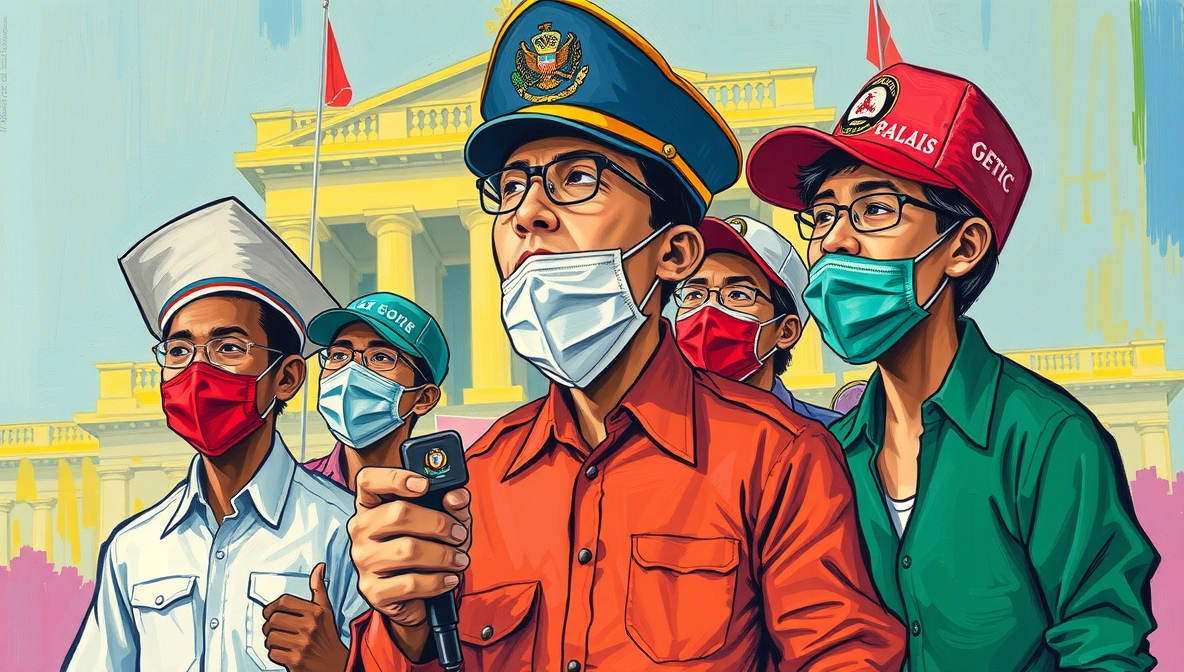
Manila Government Workers Petition for American-Style Shutdown After Learning About Paid Enlightenment Opportunity
Best Satire in the USA – Manila Bureau | November 2025
Filipino government employees have filed an unprecedented petition requesting that Manila implement American-style government shutdowns after learning that their U.S. counterparts achieve spiritual enlightenment while staying home during budget impasses. The petition, signed by over fifteen thousand civil servants, argues that Filipino workers deserve equal access to “federally mandated self-discovery” and “paid contemplation of bureaucratic futility.”
The movement began when Manila-based Bureau of Internal Revenue analyst Roberto Santos read news reports about how American federal workers were achieving enlightenment during their recent government shutdown. “I’ve been processing tax documents for twelve years and never once achieved nirvana,” Santos told reporters outside his Makati office. “The Americans get furloughed, discover the meaninglessness of their existence, and still receive back pay. We just get traffic on EDSA and existential dread with no spiritual payoff.”
The petition has gained unexpected support from multiple government agencies across Metro Manila. Department of Public Works engineers argue that a shutdown would give them time to meditate on why Manila’s flood control systems only work in PowerPoint presentations. Department of Education officials believe a temporary closure might help them achieve the clarity needed to understand why school buildings lack proper ventilation despite decades of construction budgets. One Department of Transportation planner suggested that a shutdown might be the only way to figure out what happened to all those driverless train proposals that were supposed to solve Metro Manila’s transit crisis.
Philippine Senator Maria Gonzales has emerged as an unlikely champion of the shutdown movement, though she admits her support stems from curiosity rather than conviction. “If American workers can achieve Buddha-consciousness by staying away from their desks, maybe Filipino government employees will achieve something even more profound,” Gonzales explained during a Senate hearing. “Perhaps they’ll finally understand our budget allocation system, which has eluded comprehension since the Marcos era. Actually, both Marcos eras.” Her colleagues responded with knowing nods before returning to their smartphones to check the latest basketball scores.
The Philippine bureaucracy’s complexity has led some experts to argue that a shutdown might produce different results than in America. “Filipino government workers already spend significant time waiting for signatures, approvals, and photocopies,” noted public administration professor Dr. Teresa Reyes of the University of the Philippines. “They’ve essentially been practicing enlightenment meditation for years without realizing it. A formal shutdown might just make them better at it.”
Labor unions have complicated the issue by demanding that any Manila shutdown include the same benefits American workers receive. “If we’re going to achieve enlightenment, we need back pay guarantees,” insisted Government Service Insurance System employee union president Carlos Mendoza. “You can’t reach nirvana while worrying about paying Globe bills and tuition fees. That’s just regular Manila stress with extra meditation.” Mendoza’s union has proposed a pilot program where workers would be furloughed in phases, allowing them to compare enlightenment levels across different government agencies and pay grades.
The proposal has sparked debate about whether the Philippine government could even implement a proper shutdown given its operational peculiarities. Unlike the American system where shutdowns result from budget disagreements, Philippine government dysfunction tends to manifest as selective enforcement, creative accounting, and what officials euphemistically call “flexible implementation timelines.” Several senators have questioned whether Filipino citizens would even notice if the government shut down, citing the nation’s robust tradition of accomplishing things despite rather than because of government assistance.
Manila’s business community has expressed mixed reactions to the proposal. Call center executives worry that enlightened government workers might question the cosmic significance of BPO industry tax incentives. Shopping mall developers fear that government inspectors who achieve spiritual awareness might actually start enforcing building codes. “We’ve spent decades cultivating mutually beneficial relationships with government regulators,” explained one anonymous real estate mogul. “If they all suddenly become enlightened and start seeing through our creative interpretations of zoning laws, it could seriously impact our quarterly projections.”
The movement has attracted attention from American federal workers who achieved enlightenment during their own shutdown. Several have offered to conduct virtual seminars teaching Filipino government employees how to maximize their spiritual growth during furlough periods. “The key is to spend the first week binge-watching Netflix while feeling guilty, then transition into genuine existential crisis by week two,” explained former EPA analyst Jennifer Morrison via Zoom call. “By week three, you’re ready for actual enlightenment. Just make sure you have enough rice and canned goods to last through the awakening process.”
Philippine President Ferdinand Marcos Jr. has remained notably silent on the petition, though palace insiders suggest he’s intrigued by the idea. “The President sees potential in any program that might make government workers more efficient through doing less,” revealed one anonymous Malacañang source. “Plus, if federal employees achieve enlightenment, they might stop filing complaints about office air conditioning and printer toner shortages. That alone would be worth a temporary shutdown.” The source added that Marcos has been secretly practicing meditation himself, though it’s unclear whether this is related to the shutdown proposal or just his usual strategy for enduring cabinet meetings.
International observers have noted parallels between the Manila petition and broader questions about international governance challenges. “Both the U.S. and Philippines are discovering that sometimes the best government action is coordinated inaction,” suggested political analyst Dr. James Richardson of the Council on Foreign Relations. “Though I suspect Filipino workers might achieve enlightenment faster given their extensive practice navigating bureaucratic absurdity. Americans are still relative amateurs at that particular skill.”
The proposal has also reignited debates about government efficiency and the actual value of various bureaucratic functions. Department of Agriculture employees argue that farms continued operating during previous agency reorganizations, suggesting their regulatory oversight might be optional. Bureau of Customs officials point out that smuggling continued unabated during their busiest enforcement periods, implying that their presence or absence has minimal impact on actual outcomes. One Bureau of Immigration officer achieved spontaneous enlightenment mid-interview after realizing that most of his job involves stamping documents that could be processed digitally, leading him to resign on the spot and open a vegetarian restaurant in Tagaytay.
Technology sector workers have responded to the petition by developing apps specifically for Filipino government employees seeking enlightenment during potential shutdowns. Features include “Traffic Jam Transcendence Mode” that helps users maintain spiritual awareness while stuck on Commonwealth Avenue, and “Brownout Meditation” that guides users through power interruptions with mindfulness techniques. Beta testing revealed that the apps work too well, with several testers achieving such profound detachment that they forgot to return to work even after the testing period ended.
The petition has created unexpected diplomatic complications as well. American embassy officials in Manila have been fielding questions about whether shutdown-induced enlightenment is an exportable aspect of American democracy. White House press representatives have struggled to explain how budget dysfunction leads to spiritual growth, with one spokesperson accidentally achieving enlightenment during a particularly confusing press briefing about government operations. The State Department has since issued guidance suggesting that enlightenment should not be classified as foreign aid, though the legal reasoning remains murky.
Local governments throughout the Philippines have begun experimenting with their own versions of enlightenment programs. Quezon City implemented “Contemplation Fridays” where employees spend afternoons meditating instead of processing paperwork. Davao introduced “Awareness Workshops” that help workers understand why their initiatives never seem to progress beyond the planning phase. Cebu piloted a “Mindfulness Initiative” that was immediately cancelled after employees became so mindful of government inefficiency that they staged a protest demanding actual reforms rather than just contemplating them.
Religious leaders across the Philippines have offered varying perspectives on the enlightenment movement. Catholic bishops have expressed concern that government workers might achieve Buddhist-style awareness without proper Catholic theological framework, though they acknowledge that contemplating bureaucratic futility does resemble certain Jesuit spiritual exercises. Protestant evangelical leaders have warned that enlightenment without salvation is just “well-organized confusion.” Meanwhile, actual Buddhist monks in Manila have welcomed government workers to their meditation sessions, though they note that most participants remain too attached to their cellular phones to achieve genuine detachment from material concerns.
Economic analysts have attempted to calculate the potential impact of a Manila government shutdown on the Philippine economy. Initial projections suggest that productivity might actually increase if certain regulatory agencies temporarily ceased operations, a finding that has prompted awkward silence from government officials. “We’re essentially arguing that the economy would improve if we stopped working,” admitted one Department of Trade and Industry economist. “This is either profound wisdom or devastating commentary on our effectiveness. Possibly both.” The economist has since taken an indefinite leave of absence to “process these realizations” at a beach resort in Palawan.
The private sector has begun preparing contingency plans in case the shutdown actually occurs. Banks have developed protocols for operating without central bank oversight based on the assumption that they’ve been effectively self-regulating anyway. Telecommunications companies have created frameworks for functioning without regulatory interference, which suspiciously resembles their normal operating procedures. Healthcare facilities have established procedures for continuing operations without Department of Health approvals, mainly by continuing to do exactly what they’ve always done while filing paperwork retrospectively.
Educational institutions have responded to the movement by developing curricula around “Bureaucratic Mindfulness” and “Administrative Zen.” The University of the Philippines now offers a semester-long course on “The Philosophy of Government Dysfunction” that explores whether intentional inaction differs meaningfully from accidental incompetence. Ateneo has introduced “Contemplative Governance Studies” examining whether enlightened officials would make better policy decisions or simply become better at recognizing that most policy decisions don’t matter. De La Salle has partnered with meditation centers to offer “MBA in Mindful Management” degrees, though critics argue this is just regular management education with incense and yoga mats.
As the petition gains momentum, questions arise about what Filipino government enlightenment might actually look like. Would enlightened Bureau of Customs officials finally stop smuggling? Would awakened traffic enforcers cease soliciting bribes? Would conscious public works engineers build roads that last longer than the ribbon-cutting ceremonies? Experts suggest these outcomes are unlikely, arguing that enlightenment in the Buddhist sense involves accepting reality rather than changing it, which means enlightened Filipino government workers would probably continue existing practices while feeling less conflicted about them.
The movement has also inspired creative reinterpretations of existing government programs. The Department of Social Welfare and Development has suggested that conditional cash transfer programs could include “enlightenment metrics” measuring recipients’ spiritual growth alongside nutritional outcomes. The Department of Environment and Natural Resources proposes that environmental impact statements should assess projects’ effects on collective consciousness as well as biodiversity. The Department of Information and Communications Technology has floated the idea of a national “Digital Enlightenment Platform” that would gamify spiritual awareness, earning users karma points redeemable for faster government services, though this immediately raised concerns about creating a pay-to-pray system.
Meanwhile, practical concerns about a potential shutdown continue mounting. Government workers have begun asking whether achieving enlightenment would affect their leave credits, overtime calculations, and representation allowances. Human resources departments struggle to develop policies for employees who become too enlightened to care about their performance evaluations. Union representatives debate whether enlightenment qualifies as a work-related injury requiring compensation. These mundane administrative questions threaten to overwhelm the spiritual aspirations that inspired the movement, a irony not lost on observers who note that this perfectly encapsulates the Philippine government experience.
As the debate continues, one thing becomes clear: the petition for American-style government shutdowns reveals uncomfortable truths about Filipino governance that extend far beyond temporary furloughs and spiritual awakenings. Whether this leads to genuine reform, provides temporary entertainment, or simply becomes another unfulfilled promise in the long history of Philippine government improvement initiatives remains to be seen. For now, fifteen thousand civil servants wait hopefully for their chance at federally mandated enlightenment, while checking their direct deposit accounts and wondering if spiritual awareness includes dental coverage. Spoiler alert: it doesn’t, but at least the traffic on EDSA remains consistently terrible regardless of one’s level of cosmic consciousness.
SOURCES:
- https://bohiney.com/federal-workers-achieve-enlightenment/
- https://bohiney.com/government-shutdown/
- https://bohiney.com/driverless-trains/
- https://bohiney.com/fixing-china-relations/
- https://bohiney.com/white-house-reporters/
- https://www.officialgazette.gov.ph/featured/the-philippine-bureaucracy/
- https://www.cfr.org/backgrounder/what-drives-government-shutdowns
- https://www.brookings.edu/articles/government-effectiveness-and-bureaucratic-reform/
- https://www.transparency.org/en/countries/philippines
- https://www.adb.org/countries/philippines/governance