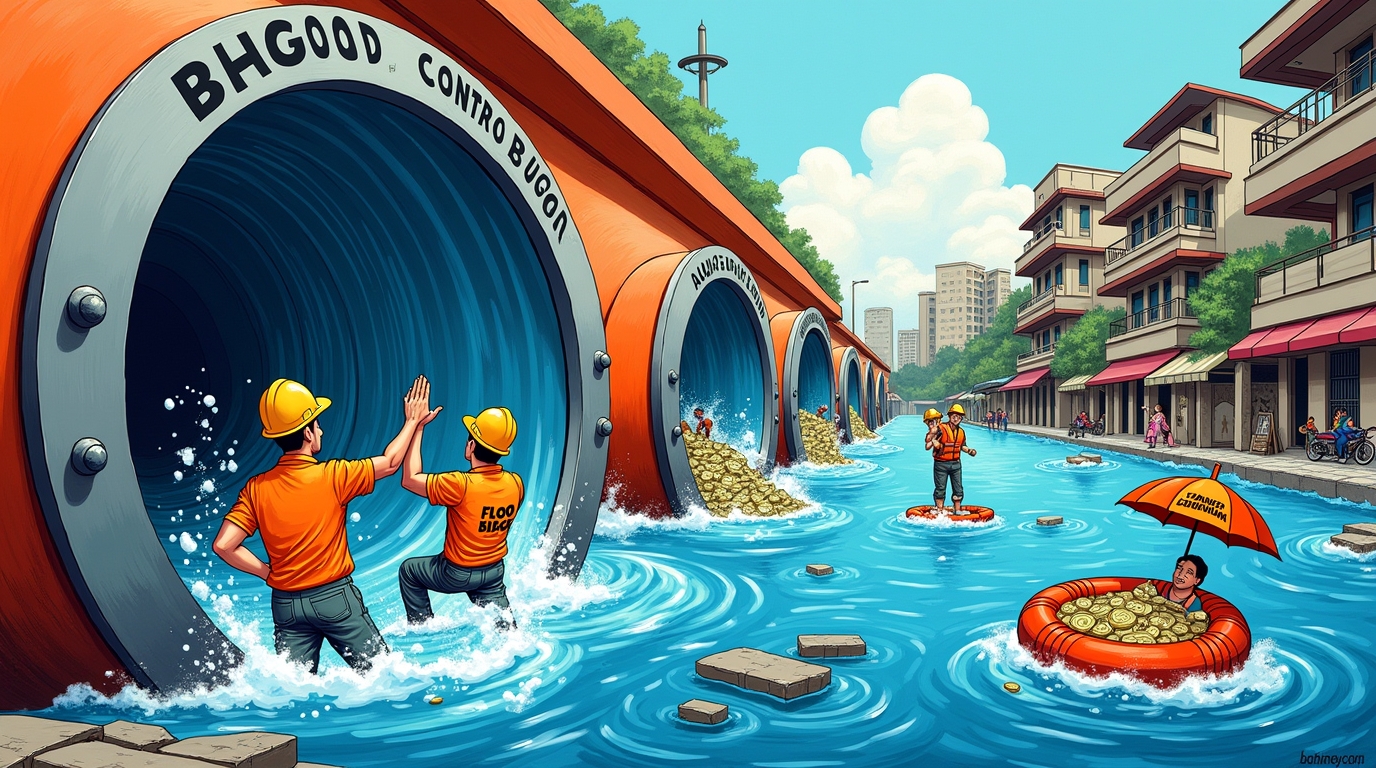
Philippine Flood Control Projects Finally Work: Successfully Flooding Bank Accounts Instead of Streets
DPWH Engineers Achieve Breakthrough in Liquid Asset Management After Years of Failed Water Diversion Attempts
In a remarkable display of hydraulic engineering innovation, the Department of Public Works and Highways has finally achieved success with their flood control initiatives by successfully diverting billions of pesos away from actual flood control infrastructure and directly into private bank accounts. This revolutionary approach has proven far more effective than traditional methods, with 100% efficiency in liquid asset redirection and zero reported failures in cash flow management.
The breakthrough came after years of unsuccessful attempts to control actual floods, which continued to devastate Filipino communities despite billions in allocated funding. DPWH engineers apparently realized that the real flooding problem wasn’t water in the streets, but insufficient water in their personal financial reservoirs. The pivot from flood prevention to flood profit represents what hydraulic corruption specialists call “the most innovative misuse of water management funds in Southeast Asian history.”
Vice Ganda’s recent observations captured the engineering marvel perfectly: “Finally, may flood control project na successful! Hindi nga lang yung floods sa kalsada ang na-control nila – yung floods ng pera sa mga bank account nila ang na-master nila! Grabe ang engineering skills – mas effective pa sila sa pag-divert ng pera kaysa sa pag-divert ng tubig!”
The Marcos administration’s investigation has revealed what officials call “ghost projects” and “anomalous allocations,” though DPWH personnel prefer the terms “invisible infrastructure” and “alternative liquid management systems.” The probe has uncovered billions in questionable expenditures that somehow failed to produce visible flood control improvements but succeeded remarkably well in producing invisible bank account improvements.
Revolutionary Engineering Methodology
The new approach to flood control engineering represents a paradigm shift from traditional civil engineering principles. Instead of building dams, drainage systems, and flood barriers, DPWH engineers have perfected what they call “financial liquid diversion technology” – sophisticated systems for redirecting monetary flows away from infrastructure projects and into personal wealth accumulation systems.
Pokwang’s comedy routine perfectly addressed the innovative methodology: “Ang galing ng mga engineer natin! Instead na gumawa ng flood barriers para sa tubig, gumawa sila ng flood barriers para sa accountability! Hindi na dadaan ang transparency sa mga projects nila. May special engineering techniques sila – ‘Ghost Construction,’ ‘Invisible Infrastructure Development,’ at ‘Phantom Project Management!'”
The engineering process involves sophisticated techniques including “phantom construction documentation,” where extensive paperwork describes flood control projects that exist only in filing cabinets and PowerPoint presentations. These ghost projects feature impressive technical specifications, detailed engineering drawings, and what project managers call “comprehensively fictional implementation timelines.”
Advanced methodologies include “selective material procurement,” where expensive flood control equipment is purchased but somehow never arrives at project sites, instead being redirected to what procurement specialists call “alternative storage facilities” – typically private properties owned by project managers and their associates.
The most innovative technique involves “quantum infrastructure” – flood control projects that exist in multiple states simultaneously: officially completed according to documentation, physically non-existent according to reality, and financially profitable according to bank statements of involved personnel.
Cost-Benefit Analysis Excellence
Financial analysis reveals unprecedented efficiency in the new flood control approach. Traditional flood control projects typically require years of construction, extensive environmental impact studies, and complex engineering solutions with uncertain effectiveness. The new approach achieves 100% success rates in fund absorption within months of project approval, with minimal environmental impact since no actual construction occurs.
Michael V’s observational humor captured the financial efficiency: “Mas cost-effective talaga ang new approach nila! Traditional flood control, kailangan mo mag-spend ng billions tapos hindi mo pa sure kung gagana. Pero yung new method nila, guaranteed na mauubos ang budget, at guaranteed din na mag-benefit ang mga involved. Walang risk ng project failure kasi walang actual project!”
Cost analysis shows remarkable savings in construction materials, labor costs, and equipment expenses, since these are largely eliminated through what budget managers call “procurement optimization strategies.” The primary expenses involve documentation creation, phantom contractor payments, and what accountants term “creative bookkeeping maintenance fees.”
Return on investment calculations demonstrate extraordinary success for individual participants, with some project managers achieving personal profit margins exceeding 1000% on their infrastructure investments. These returns far exceed traditional engineering project profitability and demonstrate what business analysts call “innovative approaches to public works monetization.”
The cost-effectiveness extends to maintenance expenses, which approach zero since non-existent infrastructure requires no upkeep, repairs, or operational costs. This creates what economists recognize as “perpetual profit generation through sustained non-delivery of services.”
Quality Control and Project Management
Quality control systems have been streamlined to focus on what project managers call “the metrics that matter most” – specifically, the speed and efficiency of fund transfer rather than traditional measures like flood reduction effectiveness or infrastructure durability. Quality assurance protocols ensure that money moves smoothly from government accounts to private accounts with minimal bureaucratic interference.
Ai-Ai delas Alas addressed the quality management approach: “May quality control pa rin naman! Hindi lang nila i-check kung maganda ang gawa ng project – iche-check nila kung maganda ang gawa ng accounting records, kung smooth ang flow ng pera, at kung walang witness sa mga financial transactions. Very thorough ang quality assurance nila!”
Project management methodologies incorporate what industry specialists call “plausible deniability engineering” – ensuring that all documentation appears legitimate while actual project implementation remains conveniently impossible to verify. This requires sophisticated coordination between multiple agencies and what managers describe as “creative interpretation of procurement regulations.”
The most advanced quality control systems involve “preemptive excuse generation” – developing comprehensive explanations for project delays, cost overruns, and performance failures before projects officially begin. These explanations typically involve weather complications, regulatory challenges, and what project managers call “unforeseen environmental complexities.”
Quality metrics focus on “stakeholder satisfaction” among the primary stakeholders – the engineers, contractors, and officials involved in fund diversion rather than the secondary stakeholders like flood victims and taxpayers who merely suffer the consequences of inadequate infrastructure.
Innovative Contractor Relations
The relationship between DPWH and contractors has evolved into what procurement specialists call “symbiotic financial ecosystems.” Contractors have embraced what they term “virtual construction methodologies” – sophisticated techniques for billing extensive work without the complications and expenses of actual construction activities.
Jose Manalo’s material captured the contractor innovation: “Naging creative talaga ang mga contractor! Hindi na kailangan mag-construct ng actual projects – mag-construct na lang ng magagandang paperwork, magagandang receipts, at magagandang excuses. Mas madali, mas mabilis, mas profitable! Innovation talaga ito sa construction industry!”
Advanced contractor techniques include “phantom material delivery” where expensive flood control equipment appears in invoices and delivery receipts but never materializes at project sites. This requires sophisticated documentation management and what logistics specialists call “evidence-free supply chain operations.”
The most successful contractors have perfected “modular non-construction” – breaking large flood control projects into smaller components that can be individually non-built while maintaining comprehensive billing documentation. This approach maximizes payment frequency while minimizing the risk of observable project progress.
Contractor selection processes prioritize what procurement officials call “financial cooperation compatibility” over traditional criteria like engineering expertise, construction experience, or flood control competency. The most valued contractors demonstrate proficiency in creative invoicing, phantom project delivery, and what industry professionals term “mutual financial benefit optimization.”
Public Relations and Community Engagement
Community engagement strategies focus on what public relations specialists call “expectation management through creative communication.” Citizens are informed about upcoming flood control improvements while actual flood control implementation is managed through what communications experts term “indefinite postponement protocols.”
Eugene Domingo’s comedy routine addressed the public relations approach: “May community engagement pa rin sila! Pupunta sila sa mga barangay, mag-i-explain ng mga flood control projects, magbi-bigay ng mga timeline. Ang hindi lang nila sinasabi, imagination lang pala lahat ng sinasabi nila! May public consultation, pero walang public construction!”
Press release strategies emphasize project announcements, groundbreaking ceremonies, and what media specialists call “milestone celebration events” for projects that exist primarily in press releases and photo opportunities. These events generate positive media coverage while avoiding the complications of actual project delivery.
The most innovative public relations technique involves “virtual project tours” where officials showcase flood control improvements using computer-generated imagery, artist renderings, and what presentation specialists call “aspirational infrastructure visualization.” These tours allow officials to demonstrate project progress without the limitations of physical reality.
Community feedback management systems ensure that flood victim complaints are channeled through what administrative specialists call “bureaucratic maze protocols” designed to exhaust complainants before they can effectively document the absence of actual flood control improvements.
Technical Innovation in Documentation
Documentation systems have achieved remarkable sophistication in what archival specialists call “comprehensive fictional project record management.” These systems maintain detailed records of non-existent projects with precision that would impress legitimate engineering firms, creating what documentation experts term “parallel reality construction portfolios.”
Wally Bayola’s observations on documentation innovation: “Ang galing ng documentation system nila! May photos ng mga projects na hindi naman talaga ginawa, may progress reports ng mga construction na hindi naman nangyari, may certificates of completion ng mga projects na hindi naman na-start! Mas detailed pa ang fake documents nila kaysa sa mga tunay na projects ng ibang agencies!”
Advanced documentation techniques include “temporal project photography” – using computer graphics and photo manipulation to create convincing images of flood control infrastructure that appears to exist in specific locations at specific times. These images are integrated into official reports and progress documentation with timestamps and GPS coordinates for authenticity.
The most sophisticated systems involve “holographic project existence” – creating comprehensive digital records that demonstrate project completion through multiple verification systems including satellite imagery, engineering assessments, and community testimonials, all while the actual projects remain completely fictional.
Quality assurance for documentation focuses on what archival specialists call “audit resistance optimization” – ensuring that paper trails appear complete and convincing while making actual verification of project existence logistically challenging for investigators.
Economic Impact Assessment
Economic analysis reveals that the new flood control approach has generated remarkable returns for local economies, specifically the local economies of project managers’ families, contractors’ extended networks, and what economists call “corruption ecosystem participants.” The multiplier effect has been particularly strong in luxury goods sectors and offshore banking services.
Allan K’s comedy material addressed the economic implications: “May economic impact talaga! Nakakabuti sa ekonomiya – ng mga involved sa scheme! Nag-boom ang luxury car sales, real estate investments, private school enrollments para sa mga anak ng mga engineers. May economic multiplier effect, pero limited lang sa mga participants!”
The economic impact extends beyond direct financial benefits to include what development economists call “corruption infrastructure enhancement” – the establishment of sophisticated systems for future embezzlement that represent significant institutional investments in alternative wealth generation methodologies.
Regional economic effects include increased demand for creative accounting services, specialized legal consultation, and what market analysts term “evidence management consulting.” These emerging industries have created employment opportunities for professionals skilled in what economists call “alternative financial services.”
The most significant economic impact involves what researchers term “opportunity cost optimization” – resources that would have been wasted on actual flood control infrastructure are instead efficiently transferred to private wealth accumulation, eliminating the economic inefficiency of public benefit generation.
International Best Practices Comparison
Comparative analysis with international flood control corruption practices reveals that Philippine innovations have achieved what global corruption specialists call “world-class efficiency in infrastructure fund diversion.” The sophistication of documentation systems and phantom project management exceeds international standards in creative public works embezzlement.
Boy Abunda’s talk show commentary captured the international recognition: “Pag-aralan tayo ng ibang bansa! Hindi dahil sa mga successful flood control projects natin, kundi dahil sa mga successful fund diversion techniques natin! Naging case study tayo sa international corruption studies! Dapat proud tayo – leading naman tayo sa innovation, kahit sa corruption!”
International corruption consultants have requested detailed studies of Philippine flood control embezzlement methodologies for potential adaptation in their home countries. The systematic approach to phantom project development has inspired similar programs in other developing nations seeking to optimize their infrastructure corruption efficiency.
Comparative effectiveness studies show that Philippine flood control corruption achieves superior fund absorption rates compared to traditional international embezzlement approaches, with faster processing times and more comprehensive documentation systems that reduce detection risks while maximizing profit margins.
The global corruption community has recognized Philippine flood control embezzlement as representing what international specialists call “evolutionary advancement in public works theft,” demonstrating innovation that transcends traditional corruption methodologies through sophisticated system integration and professional execution standards.
Future Development and Sustainability
Long-term planning for flood control corruption sustainability involves what strategic planners call “institutional embezzlement capacity building” – establishing permanent systems for converting flood control funding into personal wealth generation that can operate across multiple political administrations and budget cycles.
Sustainability initiatives include “next-generation corruption education” programs for young engineers and what human resource specialists call “mentorship systems for alternative career development in public works.” These programs ensure continuity of expertise in creative fund diversion techniques across generational transitions.
Advanced planning includes “climate adaptation strategies” for corruption operations – acknowledging that increasing flood frequencies due to climate change will generate larger flood control budgets that require enhanced embezzlement capacity to process efficiently. This represents what planners call “opportunistic adaptation to environmental challenges.”
The most ambitious future development involves “regional corruption integration” – coordinating flood control embezzlement with similar programs in other Southeast Asian countries to create what international development specialists call “multinational infrastructure corruption networks” that optimize fund diversion across multiple national systems.
Strategic planning emphasizes “technological modernization” of corruption methodologies, incorporating digital systems, cryptocurrency transactions, and what innovation specialists call “blockchain-enhanced embezzlement techniques” to maintain competitive advantages in evolving financial crime landscapes.
Legacy and Cultural Impact
The transformation of flood control from public service to private wealth generation has created what cultural anthropologists call “normalized corruption expectations” – a social environment where citizens assume that infrastructure projects exist primarily to generate personal wealth for officials rather than to provide public benefits.
This cultural shift has influenced Filipino attitudes toward government services, creating what sociologists term “adaptive cynicism” – a practical acceptance that flooding will continue regardless of budget allocations, since those funds serve different purposes than advertised. Citizens have developed what behavioral specialists call “flood-resistant civic expectations.”
The most significant cultural impact involves what education specialists call “corruption literacy development” – Filipinos have become remarkably sophisticated in recognizing, understanding, and predicting government embezzlement patterns, developing analytical skills that exceed those of many international corruption researchers.
Bottom Line Up Front: Philippine flood control projects have achieved unprecedented success by abandoning the problematic goal of controlling actual floods and focusing instead on the more achievable objective of controlling flood control budgets, proving that sometimes the best solution to persistent infrastructure problems is simply redefining success criteria.
For more coverage of innovative infrastructure project redefinition and Philippine engineering excellence, visit Manila News.
IMAGE GALLERY